
Summary
The Indo–US trade announcement has generated optimism, but a closer reading shows it is only a framework for future negotiations, not a concluded deal. While tariff relief offers short-term comfort to Indian exporters, India’s import commitments appear far more definitive than US assurances. As talks move ahead, critical questions remain around trade balance, competitiveness, and whether the agreement will truly add long-term value to the Indian economy.
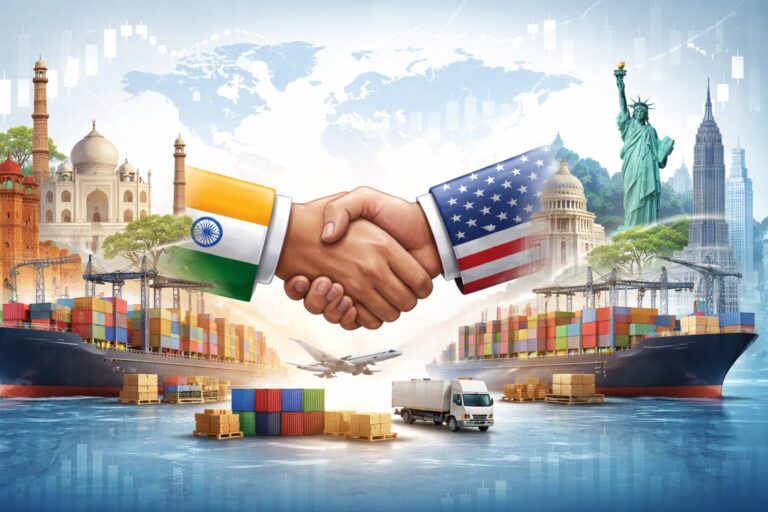
Before getting carried away by the excitement around the Indo–US trade announcement, it is important to pause and read the fine print. What India and the United States have released is not a final trade deal and not even an interim agreement. It is only a framework that will guide negotiations for an interim deal in the future. In other words, this is just the first step.
The immediate positive is the rollback of US tariffs on Indian exports from a steep 50% to about 18%. This comes as a relief for sectors such as chemicals, textiles, gems and jewellery, and marine products, which were hit hard by last year’s tariff hikes. However, this is more a restoration of the earlier position than a fresh concession.
The bigger question is what does India really gain from this arrangement?
A close reading of the joint statement shows that India’s commitments are largely definitive. India has agreed to eliminate or sharply reduce tariffs on most US industrial goods and a wide range of agricultural and food products, including items such as tree nuts, soybean oil, wine, and spirits. While sensitive areas like dairy and parts of agriculture remain protected, the overall direction is clearly towards wider market access for US goods.
More significantly, India has expressed its intention to import $500 billion worth of US goods over the next five years. This includes energy products, aircraft and parts, precious metals, advanced technology products such as GPUs, data centre infrastructure, and coking coal. At roughly $100 billion a year, this represents a 2.5 times jump over current import levels.
What remains unclear is whether these imports will be driven by competitive pricing, as in the case of oil or coal, or whether they become quasi-obligatory purchases linked to the deal.
In contrast, the US commitments appear far more conditional. Tariff concessions on aircraft parts, auto components, and pharmaceuticals are all subject to national security considerations or ongoing investigations. Experience suggests that national security is a flexible and often restrictive clause in US trade policy, and benefits linked to it may eventually amount to very little.
In effect, while India’s promises look firm, the US benefits appear contingent and reversible.
That said, the framework does offer some tangible advantages. Indian exports will face lower reciprocal tariffs than many Asian competitors. With China at 35 percent, Vietnam at 20 percent, and Indonesia at 19 percent, India’s 18 percent tariff rate improves its cost competitiveness in the US market.
Once a final agreement is reached, several Indian exports such as machinery parts, generic pharmaceuticals, textiles, and gems and jewellery could move to zero-duty status. Although these products largely sit at the lower end of the value chain, the predictability itself is valuable.
Agriculture and dairy remain largely protected, especially in sensitive areas such as GM foods, groundnuts, honey, and ethanol. This helps safeguard employment in these sectors. MSMEs, particularly in textiles, leather, and handicrafts, stand to benefit the most, as they were among the worst affected by tariff uncertainty.
Much of the confusion stems from two different $500 billion figures mentioned around the deal. One refers to India’s intention to import $500 billion of goods from the US over five years. The other is the target of $500 billion in total annual Indo–US trade by 2030, including goods and services.
Today, total trade stands at around $210 billion annually. Even if services trade doubles over the next five years, India would still need a massive increase in merchandise exports to bridge the gap. This would require tripling India’s goods exports to the US, a target that raises serious questions about feasibility.
Apart from the confusion, there are several uncomfortable issues that remain unresolved. Reports suggest that the US may have eased penal tariffs based on India reducing or stopping oil purchases from Russia, an expectation that may not be practical in the near term. There is also the risk that India continues exporting low value-added products while importing high-value technology and capital goods, limiting any real upgrade in trade sophistication.
Finally, the scale of the proposed imports raises concerns about dollarisation. A $500 billion import bill over five years could put additional pressure on the rupee at a time when the USD-INR is already under stress.
This trade framework is not the final word. It opens the door, but what lies beyond depends entirely on how the negotiations unfold. For now, optimism should be tempered with caution. The challenge for policymakers will be to ensure that the final deal is not just politically appealing, but economically value accretive for India Inc and the broader economy.
Related Tags


 IIFL Customer Care Number
(Gold/NCD/NBFC/Insurance/NPS)
1860-267-3000 / 7039-050-000
 IIFL Capital Services Support WhatsApp Number
+91 9892691696
Download The App Now


Follow us on


2026, IIFL Capital Services Ltd. All Rights Reserved

IIFL Capital Services Limited - Stock Broker SEBI Regn. No: INZ000164132 (Member ID - NSE: 10975 BSE: 179 MCX: 55995 NCDEX: 01249), DP SEBI Reg. No. IN-DP-185-2016, IA SEBI Regn. No: INA000000623, Merchant Banker SEBI Regn. No. INM000010940, RA SEBI Regn. No: INH000000248, BSE Enlistment Number (RA): 5016, AMFI-Registered Mutual Fund Distributor & SIF Distributor
ARN NO : 47791 (Date of initial registration – 17/02/2007; Current validity of ARN – 08/02/2027), PFRDA Reg. No. PoP 20092018, IRDAI Corporate Agent (Composite) : CA1099

This Certificate Demonstrates That IIFL As An Organization Has Defined And Put In Place Best-Practice Information Security Processes.