

The Indian stock market witnessed a sharp decline on Monday, beginning the week on a bearish note. The Nifty 50 slipped below its key support level of 24,300, falling more than 2% to touch an intraday low of 23,698 around 12:30 PM IST. Meanwhile, the Sensex also dropped significantly, plunging over 2,000 points in early trade to hit a low of 76,423.
Market breadth remained extremely weak. Out of the 50 stocks in the Nifty index, only Wipro managed to stay in the green, gaining 0.77%, while the remaining stocks traded in negative territory. Tata Passenger Vehicles, State Bank of India, and Mahindra & Mahindra were among the biggest laggards, each declining by more than 5%.
The sharp sell-off in Indian equities comes amid rising geopolitical tensions in the Middle East. The US-Iran conflict has now entered its second week, with no clear signs of de-escalation. This growing uncertainty, along with several global and domestic factors, has weighed heavily on investor sentiment and triggered widespread selling in the markets.
Here is a simplified breakdown of the key reasons behind today’s market decline.


One of the biggest triggers for the market weakness is the sudden jump in global crude oil prices. Brent crude oil surged above $100 per barrel for the first time since 2022 after tensions between the US-Israel alliance and Iran intensified. At one point, Brent crude jumped nearly 29% to around $119.50 per barrel, while US crude (WTI) also surged sharply.
Higher oil prices are a major concern for global markets because they can:
Increase inflation
Raise transportation and production costs
Slow down economic growth
For oil-importing countries like India, rising crude prices can also worsen the trade deficit and weaken the currency.
Companies depending on crude oil declined with Asian Paints, UltraTech Cement, ONGC, Coal India, and Reliance Industries ranking among the major losers.
The ongoing conflict between Iran and Israel have left a mark on the geopolitical and economics of the world. Investors fear that if the conflict escalates further, it could disrupt oil supply from the Middle East, which is one of the world’s most important energy-producing regions.
Because of this uncertainty, investors across global markets are reducing risk exposure, which has led to broad selling in equities.
The spike in energy prices is also increasing worries about inflation rising again globally.
Higher oil prices tend to push up the cost of goods and services. If inflation rises, central banks may delay interest rate cuts.
These concerns triggered selling in global bond markets as well. The US 10-year Treasury yield moved higher, while government bond yields in countries like Australia, Germany, and Japan also surged.
Rising bond yields generally make equities less attractive for investors.
The US dollar strengthened amid global uncertainty. When the dollar rises, it often leads to capital moving out of emerging markets like India. This has also pushed the Indian rupee below the ₹92 per dollar mark, adding pressure on domestic equities. A weaker rupee increases import costs and can hurt companies that rely heavily on imported inputs.
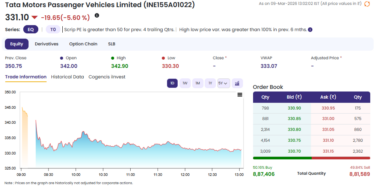
Apart from global factors, some sectors are seeing profit-taking after recent gains. Auto stocks such as Tata Passenger Vehicles, Mahindra & Mahindra, in particular, have witnessed selling as investors booked profits after a period of strong performance and turned cautious about near-term demand. Amid the global uncertainty, investors often reduce exposure to cyclical sectors first.
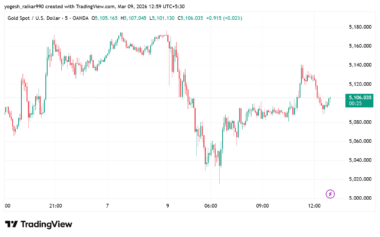
Gold dropped about 0.8% to around $5,130 per ounce, after falling more than 2% earlier in the session. The decline was mainly due to the stronger US dollar and profit booking after the recent rally.
Another reason is that investors now expect the US Federal Reserve to keep interest rates steady at its upcoming meeting on March 18. According to the CME FedWatch Tool, the probability of the Fed holding rates in June has risen to more than 51%, up from below 43% last week.
Higher interest rates tend to reduce the appeal of gold since it does not offer any yield.
The India VIX (Volatility & Fear Index) also surged sharply by 22% to 24.30, moving closer to levels that typically signal heightened caution and panic among investors.
While sharp market declines can create anxiety among investors, it is important to remember that periods of heightened volatility are a normal part of stock markets. Episodes driven by global uncertainty and geopolitical tensions often lead to short-term reactions, even though underlying economic fundamentals may remain unchanged.
Investors may benefit from avoiding panic-driven decisions during such phases. Instead, maintaining a disciplined approach, focusing on long-term investment goals, and ensuring proper portfolio diversification can help through periods of market turbulence more effectively.
Historically, markets typically stabilise once clarity emerges on global developments and macroeconomic trends. Until then, participants are likely to remain cautious, with volatility expected to persist in the near term.
Related Tags


 IIFL Customer Care Number
(Gold/NCD/NBFC/Insurance/NPS)
1860-267-3000 / 7039-050-000
 IIFL Capital Services Support WhatsApp Number
+91 9892691696
Download The App Now


Follow us on


2026, IIFL Capital Services Ltd. All Rights Reserved

IIFL Capital Services Limited - Stock Broker SEBI Regn. No: INZ000164132 (Member ID - NSE: 10975 BSE: 179 MCX: 55995 NCDEX: 01249), DP SEBI Reg. No. IN-DP-185-2016, IA SEBI Regn. No: INA000000623, Merchant Banker SEBI Regn. No. INM000010940, RA SEBI Regn. No: INH000000248, BSE Enlistment Number (RA): 5016, AMFI-Registered Mutual Fund Distributor & SIF Distributor
ARN NO : 47791 (Date of initial registration – 17/02/2007; Current validity of ARN – 08/02/2027), PFRDA Reg. No. PoP 20092018, IRDAI Corporate Agent (Composite) : CA1099

This Certificate Demonstrates That IIFL As An Organization Has Defined And Put In Place Best-Practice Information Security Processes.