
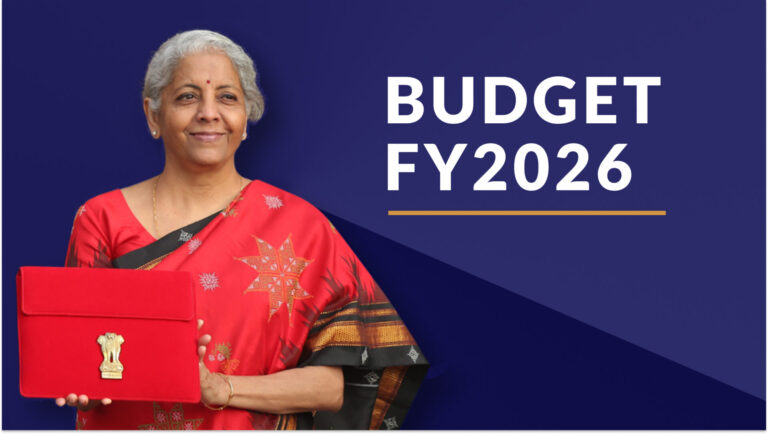
Summary
The expectations on the direct tax front were limited due to the incomes up to ₹12.75 lakhs already being made tax-free in the previous year. Also, with the new Income Tax Code being implemented, it was more of wait and watch for the government.
There may have been some disappointment on the capital gains front and the STT front. However, it must be noted that the government has delivered sops for the buybacks and also specific benefits for IT and cloud companies. Overall, it balances out!
DIRECT TAXES – LIMITED EXPECTATIONS AHEAD OF NEW TAX CODE
The Budget was presented just a couple of months ahead of the implementation of the new tax code effective from April 01, 2026. This is a fairly simplified code with substantially reduced number of sections. This replaces the Income Tax 1961 and is considered to be much more in tune with the changing times.
One of the big changes that has been introduced is the Single Tax Year. Till now, there was the persistent confusion between assessment year and the previous year (Financial year). For example, your earnings for FY26 are considered to correspond to the previous year (financial year) FY27 and assessment year FY27. Now, there will be just one year called the Tax Year and the classification of assessment year and financial year is done away with.
NO CHANGE IN INCOME TAX RATES WAS ALONG EXPECTED LINES
The central government had taken up a substantial reduction of direct tax rates as of the Union Budget 2025-26. At that point, the income up to ₹12 lakhs was made tax-free through rebate under Section 87A of the Income Tax Act. On top of that, the new tax regime (NTR) had standard deviation of ₹75,000; making the effective exempt income ₹12.75 lakhs. With this kind of liberal limits, anything further would not have been practical.
There were some demands for a lower tax slab for the higher income groups. However, with the net tax revenues falling short of expectations and India’s tax to GDP ratio still woefully short of global benchmarks, the government had to let it pass. The standard deduction has also been maintained at ₹75,000 under the NTR and at ₹50,000 under the OTR.
SOME DISAPPOINTMENT ON THE CAPITAL GAINS TAX FRONT
There was surely some disappointment on the capital gains tax front. People were expecting that the base exemption limit would be increased from ₹1.25 lakhs to ₹2.00 lakhs or an exemption for equities held beyond 5 years. The government did not tinker with either of these items. However, there was some positive news on the buyback front.
Effective November 2024, buyback proceeds were treated as dividend income in the hands of the investor. However, the cost of the stock was treated as a capital loss. Hence that could only be written off against other capital gains and not against the buyback proceeds. This created a huge dichotomy and discouraged buybacks in the last one year. That has been rationalized by the Union Budget 2026-27.
The government has continued to keep the onus of the taxation on the investor. However, buybacks will now be treated as capital gains and so they only have to pay concessional tax on the gain amount. Also, the rate of tax would be higher in case of a corporate promoter group and still higher in case of individual promoters. However, this is still a more rational way of taxing buybacks compared to treating proceeds as dividend income.
BUT, SOME REAL DISAPPOINTMENT ON STT
There was some real disappointment for investors and traders on the securities transaction tax (STT) front. The positive side of the story is that the equities and equity mutual funds have been kept out of the purview of STT increase. However, there has been a meaningful increase in STT rate on futures and options.
For instance, the rate of STT on futures has been increased from the current 0.02% to 0.05%, a hike of 150% in absolute terms. At the same time, the STT on options was also increased from 0.10% to 0.15%, a 50% spike in absolute terms. It must be noted that STT on futures is charged on notional value while STT on options is charged on the premium value.
The disappointment is more because it is likely to make the economics of a trade a lot tighter when the retail investors have already deserted the F&O market in large numbers. It may be a move to discourage retail investors from speculating in F&O, but it could have larger implications for the performance of equity portfolios and MF portfolios too.
OTHER TAX-RELATED CHANGES OF INTEREST TO INVESTORS
There were other changes to, which are more procedural in nature. For instance, the July 31 tax filing deadline will now only apply to assessees filing tax using Form 1 and Form 2. For others filing as non-audit cases, the deadline for tax will be August 31. Of course, for the audit cases, the tax filing deadline comes still later. The other change is that, now, late filers can also claim TDS refund, even if the filing is done after the deadline.
There were also some benefits for corporates. The budget NRIs filing tax returns under the presumptive scheme from paying minimum alternate tax (MAT). Also, the safe harbour threshold for IT companies has been raised from ₹300 crore to ₹2,000 crore; reducing transfer pricing disputes. Also, there will be a tax holiday up to 2047 for global companies offering cloud services using Indian data centres.
Overall, the budget did not deliver too much on the direct taxes front, and even disappointed on some fronts. However, not too much was expected anyways.
Related Tags


 IIFL Customer Care Number
(Gold/NCD/NBFC/Insurance/NPS)
1860-267-3000 / 7039-050-000
 IIFL Capital Services Support WhatsApp Number
+91 9892691696
Download The App Now


Follow us on


2026, IIFL Capital Services Ltd. All Rights Reserved

IIFL Capital Services Limited - Stock Broker SEBI Regn. No: INZ000164132 (Member ID - NSE: 10975 BSE: 179 MCX: 55995 NCDEX: 01249), DP SEBI Reg. No. IN-DP-185-2016, IA SEBI Regn. No: INA000000623, Merchant Banker SEBI Regn. No. INM000010940, RA SEBI Regn. No: INH000000248, BSE Enlistment Number (RA): 5016, AMFI-Registered Mutual Fund Distributor & SIF Distributor
ARN NO : 47791 (Date of initial registration – 17/02/2007; Current validity of ARN – 08/02/2027), PFRDA Reg. No. PoP 20092018, IRDAI Corporate Agent (Composite) : CA1099

This Certificate Demonstrates That IIFL As An Organization Has Defined And Put In Place Best-Practice Information Security Processes.