15 Jul 2026 , 02:31 PM
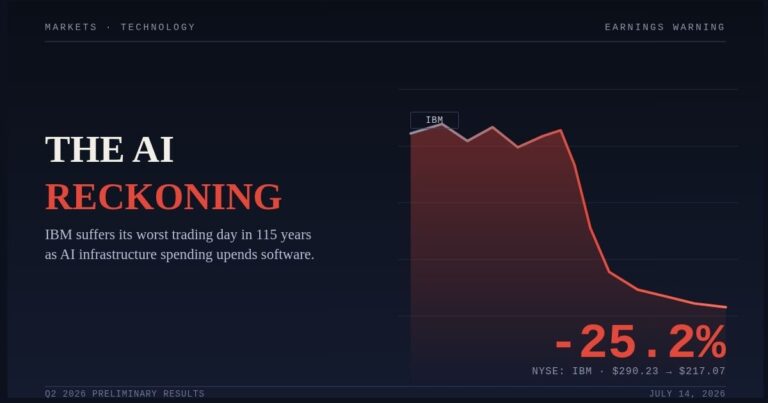
What happens when technology companies confess themselves that they are late for the next phase of business? Something similar happened and IBM got an answer to this question this week. In a single trading session, the company lost roughly a quarter of its value — nearly $70 billion evaporating from the market capitalization of a company that has been publicly traded since 1916. It was the worst day in IBM’s history, worse than anything the company endured during Black Monday in 1987, worse than the dot-com collapse, worse than the 2008 financial crisis. For a firm built on a reputation of stability — “nobody ever got fired for buying IBM” — this was, in every sense, a rupture.
What makes the crash so striking isn’t the size of the earnings miss. By the numbers, it was almost modest: revenue of around $17.2 billion against Wall Street’s expectation of roughly $17.86 billion, a shortfall measured in the hundreds of millions rather than billions. What spooked investors wasn’t the arithmetic. It was the admission behind it.
CEO Arvind Krishna did not hide behind the usual corporate hedges. In a letter to shareholders, he said plainly that IBM had “faltered.” The company, he admitted, “did not adapt and move quickly enough” as customers rewired their spending priorities around artificial intelligence.
That kind of candor is rare from a sitting CEO, and it is precisely why the market punished IBM as severely as it did. Investors can usually forgive a bad quarter. What they cannot easily forgive is the sense that a company’s leadership was caught flat-footed by a shift it should have seen coming — and said so, in writing, for the record.
Krishna’s explanation was straightforward: in the final weeks of the quarter, clients diverted their capital spending away from software and mainframes and toward servers, storage, and memory, racing to lock in AI infrastructure before supply constraints pushed prices higher. IBM had planned for some of this. It had not planned for the scale of it.
The uncomfortable truth buried in IBM’s numbers is that the AI boom hasn’t stopped enterprises from spending — it’s just changed where they’re willing to spend. Infrastructure revenue fell 7%, dragged down by softness in IBM’s flagship mainframe business. Software grew a modest 5%, but even that fell short of what the market wanted to see. Red Hat, one of IBM’s few genuine growth engines, managed an 11% gain. And revenue from servers and storage outside the mainframe line — the hardware directly feeding the AI buildout — jumped 37%.
Put those numbers side by side and the story writes itself: customers are not cutting technology budgets. They are reallocating them, aggressively, toward the physical infrastructure of AI, and away from the licensing and consulting revenue that has long been IBM’s bread and butter.
The market didn’t treat this as an isolated IBM problem, and that’s the part worth paying attention to. Shares of Microsoft, Salesforce, ServiceNow, and Intuit all slid in sympathy, as investors began asking a question that has been simmering under the surface of the AI boom for a while: what happens to the software-as-a-service model when AI infrastructure spending starts eating its lunch?
There’s a second, quieter story running alongside this one. As AI-powered cyber threats have grown more sophisticated, businesses have also been redirecting budget toward cybersecurity — sometimes at the expense of the very technology projects IBM was counting on to close. Cybersecurity stocks were among the day’s few winners; CrowdStrike jumped around 12%, and Okta and Netskope each rose roughly 11%. Enterprises, in other words, are not spending less. They’re spending more selectively, and IBM’s traditional strengths didn’t make the cut this quarter.
None of this means IBM’s long game is dead. The company is still leaning hard into diversification — Red Hat’s cloud platform, AI partnerships, enterprise AI tools, and a more than $10 billion commitment to large-scale quantum computing by 2029. It has also rolled out Lightwell, a $5 billion push to shore up vulnerabilities in open-source software, backed by heavyweight financial institutions including Bank of America, JPMorgan Chase, and Goldman Sachs.
The problem is timing. Quantum computing and next-generation AI partnerships are multi-year bets, and multi-year bets don’t pay quarterly dividends. Right now, they’re not offsetting the erosion in IBM’s core business — and Wall Street, it turns out, has very little patience for a growth story that hasn’t started growing yet.
IBM will report its full second-quarter results on July 22, and that call will matter more than usual. The company needs to answer a question that goes well beyond one bad quarter: is this AI-driven reshuffling of enterprise budgets a temporary supply squeeze that resolves itself, or is it the leading edge of a genuine structural shift in how businesses spend on technology?
If it’s the former, IBM’s crash will look, in hindsight, like an overreaction — a stumble, not a fall. If it’s the latter, this week’s letter from Arvind Krishna may be remembered as the moment a 115-year-old company admitted, in real time, that it had fallen behind the future it helped invent.
Related Tags


 IIFL Customer Care Number
(Gold/NCD/NBFC/Insurance/NPS)
1860-267-3000 / 7039-050-000
 IIFL Capital Services Support WhatsApp Number
+91 9892691696
Download The App Now


Follow us on


2026, IIFL Capital Services Ltd. All Rights Reserved

IIFL Capital Services Limited - Stock Broker SEBI Regn. No: INZ000164132 (Member ID - NSE: 10975 BSE: 179 MCX: 55995 NCDEX: 01249), DP SEBI Reg. No. IN-DP-185-2016, PMS SEBI Regn. No: INP000002213, IA SEBI Regn. No: INA000000623, Merchant Banker SEBI Regn. No. INM000010940, RA SEBI Regn. No: INH000000248, BSE Enlistment Number (RA): 5016, AMFI-Registered Mutual Fund Distributor & SIF Distributor
ARN NO : 47791 (Date of initial registration – 17/02/2007; Current validity of ARN – 08/02/2027), PFRDA Reg. No. PoP 20092018, IRDAI Corporate Agent (Composite) : CA1099

This Certificate Demonstrates That IIFL As An Organization Has Defined And Put In Place Best-Practice Information Security Processes.