
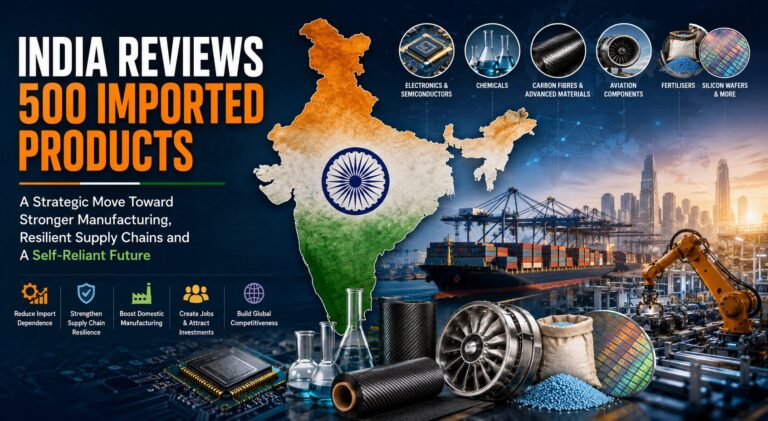
The Indian government is quietly undertaking an exercise that could have significant implications for the country’s manufacturing future. Officials are examining nearly 500 heavily imported products from machinery and chemicals to silicon wafers, carbon fibres, fertilisers, and aviation components to identify areas where domestic production can be increased.
At first glance, this may appear to be another bureaucratic review. It is not.
Behind the exercise lies a much larger concern: India’s growing dependence on imports and the vulnerabilities that come with it.
In FY26, India’s goods import bill stood at nearly $775 billion. Crude oil alone accounted for around $174 billion, while electronics imports crossed $116 billion. Gold imports stood at roughly $72 billion, and chemical imports stood at $28 billion.
These are not small numbers. They represent a significant outflow of foreign exchange and a reminder that many critical sectors of the Indian economy still depend heavily on overseas suppliers.
The government’s latest exercise is therefore not just about reducing imports. It is about strengthening India’s manufacturing base, improving supply-chain resilience, and ensuring that external disruptions do not threaten domestic industries.
Over the past few years, businesses and governments around the world have learned an uncomfortable lesson: supply chains are only reliable until they are not.
The pandemic exposed vulnerabilities in global manufacturing networks. Geopolitical tensions disrupted trade routes. More recently, instability in West Asia has raised concerns over shipping lanes and the availability of critical goods.
For a country like India, which relies heavily on imported products across several sectors, these disruptions can quickly become economic challenges.
That is why policymakers are now focusing on localisation.
The idea is simple. If India can manufacture more products domestically, it becomes less dependent on global uncertainties and better prepared for future disruptions.
The Department for Promotion of Industry and Internal Trade (DPIIT) is collecting information from various ministries and industries to understand where India can realistically build domestic manufacturing capabilities.
The exercise is examining:
Current levels of import dependence
Existing domestic production capacity
Investment required to scale manufacturing
Time needed to build local capabilities
Industrial bottlenecks
Strategic importance of products
Officials are trying to answer a basic but important question: Which products can India manufacture competitively instead of importing?
The answer will likely shape future industrial policies and investment priorities.
Among the sectors being examined, electronics and chemicals stand out.
India imports a large volume of electronics every year despite its growing ambitions to become a global manufacturing hub. Semiconductors, electronic components, and advanced technology products continue to be sourced largely from abroad.
At the same time, electronics remains one of the country’s biggest export opportunities.
The same is true for chemicals.
India has built a strong position in certain segments of the chemical industry, but dependence on imported specialty and industrial chemicals remains high. Expanding domestic production could reduce imports while creating export opportunities.
This dual opportunity in reducing imports while increasing exports is what makes these sectors particularly attractive.
It is important to recognise that importing goods is not inherently negative. Every major economy imports products. The concern arises when dependence becomes excessive. According to officials, products where more than 60% of domestic demand is met through imports are considered highly import-dependent. Products where imports account for 30–60% of demand fall into the medium-dependence category.
The government’s focus is on reducing this dependence in sectors that are strategically important and commercially viable for domestic production.
While around 500 products are being examined, officials expect that nearly 100 products may eventually be shortlisted for focused localisation efforts.
These are likely to be products where:
Import dependence is high
Domestic demand is strong
India already possesses some manufacturing capability
Scaling production is commercially feasible
In other words, the government is looking for areas where relatively targeted interventions can produce meaningful results.
The real significance of this exercise is not simply replacing imports.
If executed effectively, localisation can create a much larger economic impact.
More domestic manufacturing means:
Higher industrial output
Job creation
Increased investments
Stronger supply chains
Better technological capabilities
Lower foreign exchange outflows
Most importantly, it helps build industrial capacity that can eventually compete globally. This is exactly how countries such as South Korea, China, and several Southeast Asian economies expanded their manufacturing strength over time.
The opportunity is clear, but so are the challenges. Building manufacturing capability is not as simple as deciding to produce something locally.
Many of the products under consideration require: Advanced technology, Skilled labour, Large-scale capital investment, Global quality standards, Reliable supply chains
In some cases, building competitive domestic industries may take years.
There is also the risk of creating protection without competitiveness. Local manufacturing can succeed only if products meet international standards on quality, cost, and reliability.
The objective should not be to produce everything in India at any cost. The objective should be to produce strategically important products efficiently and competitively.
India’s examination of 500 heavily imported products may not generate the same headlines as major infrastructure projects or billion-dollar investment announcements. Yet it could prove equally important.
The exercise reflects a broader shift in economic thinking from simply participating in global supply chains to building stronger domestic capabilities within them. The coming years will determine whether India can convert its large domestic market into a globally competitive manufacturing base.
If successful, this initiative could reduce import dependence, strengthen industrial resilience, and support the country’s ambition of becoming a major manufacturing power.
If not, India’s import bill will continue to grow, and many of the opportunities created by global supply-chain realignments may be captured elsewhere.
The government’s review of 500 products is therefore about much more than imports. It is ultimately about how much of India’s future growth will be built at home.
Related Tags


 IIFL Customer Care Number
(Gold/NCD/NBFC/Insurance/NPS)
1860-267-3000 / 7039-050-000
 IIFL Capital Services Support WhatsApp Number
+91 9892691696
Download The App Now


Follow us on


2026, IIFL Capital Services Ltd. All Rights Reserved

IIFL Capital Services Limited - Stock Broker SEBI Regn. No: INZ000164132 (Member ID - NSE: 10975 BSE: 179 MCX: 55995 NCDEX: 01249), DP SEBI Reg. No. IN-DP-185-2016, IA SEBI Regn. No: INA000000623, Merchant Banker SEBI Regn. No. INM000010940, RA SEBI Regn. No: INH000000248, BSE Enlistment Number (RA): 5016, AMFI-Registered Mutual Fund Distributor & SIF Distributor
ARN NO : 47791 (Date of initial registration – 17/02/2007; Current validity of ARN – 08/02/2027), PFRDA Reg. No. PoP 20092018, IRDAI Corporate Agent (Composite) : CA1099

This Certificate Demonstrates That IIFL As An Organization Has Defined And Put In Place Best-Practice Information Security Processes.