
AI or Artificial Intelligence is no more only a TV or Movie plot. It is real. More than real, it has now become an everyday tool. A tool so powerful that it has held people wondering – what the future holds? But before we start picturing the future of Humanity, let’s come back to reality and check what is really happening in the AI Space. So, the latest report is Anthropic filing its IPO papers. After only 5 years of service, this AI company is already going public. But as it goes public, much attention is now shifted to the numbers it presented. Let’s break these numbers down and understand what each number stands for, and how to judge them.
Let’s start from the beginning..
Anthropic PBC (note this PBC will discuss later what it means and why it is an important term), the company behind Claude, was founded in January 2021, by seven former OpenAI employees including CEO Dario Amodei and his sister Daniela Amodei. The founders created Anthropic with a focus on developing advanced AIs.
As you may know – running a AI company requires a lot of capital. Why? Because AI isn’t just a software running inside computers. It is a product of enormous computing infrastructure, specialised chips, data centres, electricity and high-performance servers to train and operate AI models. And to start with – Anthropic initially received $124 million in funding with some notable early investors including Sam Bankman-Fried, the founder of now defunct crypto exchange FTX.
However, after FTX went bankrupt, their investment became part of the bankruptcy estate. Therefore in 2024 Anthropic sold their stake for around $1.3 billion resulting in them making $800 million in profit.
Since its founding, Anthropic has become one of the most watched companies in the AI industry globally. This is due to them seeing increased adoption of their Claude AI. They have seen incredible growth in their revenue. From only $41 million in 2023 their revenue rocketed to $386 million in 2024 and then $4.6 billion in 2025. In 2026 the company saw an incredible surge in their revenue with them making $16.3 billion in the first 6 months of 2026.
| Period | Revenue |
|---|---|
| 2023 | $41 million |
| 2024 | $386 million |
| 2025 | $4.6 billion |
| First half of 2026 | $16.3 billion |
However, this growth has not come without cost. As they are developing, training and using advanced AIs, they require a huge amount of computing power. For every time someone uses Claude they are using computing power. Anthropic uses computing infrastructure provided by tech companies like Amazon and Google. Effectively they are leasing computing power. This means they could experience incredible revenue growth but this will also result in higher costs. As reported in their IPO papers filed with SEC, the company made a loss of around $42 billion in 2025.
Anthropic has big plans for the future.
They launched Claude Cowork, an innovative tool to help users automate tasks in the office in January 2026. They have since launched plugins which integrate Claude into more than 10 industries. This has caused some concern for investors. If companies can use AI tools to do tasks, that were traditionally done by specific software products, then companies within these sectors could face increased competition and pressure on their price. This is when the market reacted badly. Software companies lost around $285 billion. Interestingly, concerns over disruption caused by AI didn’t affect Anthropic’s popularity. They raised $30 billion in February 2026 with a valuation of $380 billion.
Anthropic have had some conflict with the US Government. They have refused to let their AI be used for mass surveillance of US citizens or autonomous weapons that can select and shoot targets independently. This conflict escalated on the 27th February 2026 when the Pentagon listed Anthropic as a supply chain risk. Whilst this does raise concerns around their relationship with the Government, it doesn’t seem to have a huge financial impact. Less than 2% of their revenue comes from Government related businesses.
Now, this is where everyone has their eyes glued to. One of the most discussed topics of the IPO papers was the number $80.7 Billion that attracted the investor spotlight. And why shouldn’t it?
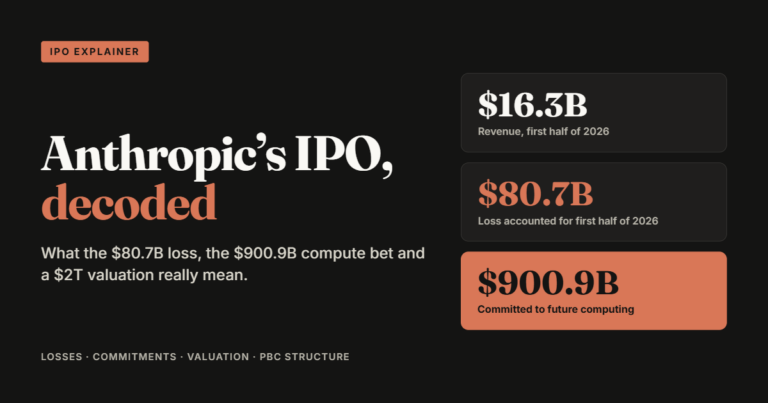
In its filings, Anthropic said it made $16.3 billion in revenue in the first half of 2026 but also made a loss of $80.7 billion. The loss figures are not twice or thrice bigger than the revenue numbers, but are actually huge. However, this loss isn’t actually as bad as it sounds.
Let’s simplify – Anthropic said that a large portion of this reported $80.7 Billion loss was due to accounting adjustments. What does this mean? When companies such as Amazon and Google invested in Anthropic, certain arrangements involved commitments to issue shares at a later date. As Anthropic’s valuation increased, the accounting value of these future share commitments also increased. Under the applicable accounting treatment, this increase in the value of the company’s obligations had to be recognised as a loss in its financial statements. The reported breakdown highlights the difference between the accounting loss and the actual cost of running the business.
| Particulars | Amount |
|---|---|
| Total reported loss | $80.7 billion |
| Accounting-related loss | $72.4 billion |
| Operating loss from selling Claude | Approximately $700 million |
So, in reality, Anthropic’s actual loss from service expenditure accounts for $700 million. So around $72.4 billion of their loss was due to non-cash accounting. This is important as it doesn’t mean Anthropic has lost $80.7 billion in cash. Interestingly, Amazon reported over $60 billion in gains from these arrangements. As the value of the investment related agreements increased, it showed up as a loss for Anthropic but a gain for Amazon.
And, a better thing – Anthropic sits over a large amount of cash in hand with around $132 billion.
But if everything looks good, why are investors worried?
Whilst their loss of $80.7 billion has grabbed attention, there is one specific number that has raised even bigger concern. And that number is bigger too. It is $900.9 Billion.
Anthropic has signed long-term agreements with technology companies to secure computing power and infrastructure. These agreements include minimum spending requirements, which means that the company must make payments even if it does not use all the computing capacity it has booked.
As of and after September 30, 2026, Anthropic had committed to spending approximately $900.9 billion on computing infrastructure and related resources.
Here’s how these payments are spread out:
$70.7 billion is due over the next 12 months.
$451.6 billion is expected to be spent before December 31, 2030.
In simple terms, Anthropic has locked itself into nearly $901 billion of future spending, largely to secure the computing infrastructure needed to run and expand its AI business. Even if it does not fully utilise the infrastructure, it may still have to pay for much of what it has committed to.
| Technology company | Reported commitment |
|---|---|
| Broadcom | $160 billion |
| $120 billion | |
| Amazon | $110 billion |
| Microsoft | $45 billion |
| SpaceX’s AI business | $120 billion |
These are just some of the commitments the company has made mentioned. Some of these are also conditional and can be cancelled. However, the amount they have committed to is impressive. They have $70 billion to pay in the next 12 months and almost $450 Billion to pay before 2031.
AI requires specialised chips, data centres, electricity and high performance computing. As demand for AI increases, companies will need to secure infrastructure early to ensure they have enough capacity to train and run their models. By securing computing now, Anthropic could prevent shortages in the future.
However, there is a risk.
If demand for Claude and other AI products increases as expected, they will make enough revenue to justify the investment. But if demand doesn’t increase as expected, they could be paying for computing they aren’t using. And, if they don’t anticipate enough demand in the future, they may also have to pay more for extra computing which could affect their margins. This means one of the most important decisions they have to make is around their infrastructure.
Despite their large infrastructure commitments and losses, they are about to make their potential historic debut onto the stock market. They filed their IPO documents confidentially on the 1st June 2026.
| Particulars | Details |
| Proposed ticker | ANT |
| Expected valuation | $1.5 trillion–$2 trillion |
| Lead investment banks | Goldman Sachs and Morgan Stanley |
| Participating investment banks | 22 |
| Potential retail allocation | 15%–20% |
However, the valuation is quite high. If they are valued at $1.5 Trillion they are worth around 43 times their trailing 12 month revenue. At $2 Trillion it would be around 57 times their revenue, which is very high!
Investors would be paying a large amount for the expectation that their revenues will continue to grow, with increased adoption of AI and Anthropic becoming a leading player. This leaves little room for disappointment. If demand from their customers doesn’t increase, if their infrastructure costs increase or if competition increases then investors could be influenced.
The main issue, Anthropic is facing is ensuring they invest in the right amount of infrastructure. Their CEO Dario Amodei has admitted there is a risk of over-investing in computing. And they are investing an incredible amount of money now based on the expectation that demand for AI will increase.
So, there are 3 main outcomes.
1. AI demand increases as expected. If businesses and consumers continue to rapidly adopt Claude then they will make enough revenue to justify their infrastructure. They will also have more computing power meaning they can create more advanced models giving them a competitive edge.
2. AI demand increases slower than expected. If they don’t get the same level of adoption from customers then they may have large infrastructure costs. They may be paying for computing they aren’t using which could affect their margins.
3. They underestimate demand. They may not anticipate enough demand and therefore may face shortages in their infrastructure. They may have to pay much more for extra computing.
Ultimately, how well they can predict demand will determine if their aggressive expansion plan will pay off.
There are 3 key points to take from Anthropic’s finances.
The valuation they are looking to achieve of $1.5-$2 Trillion means investors are paying a large amount for future growth. Therefore, it is important Anthropic delivers.
Yes – this is the exact point where we can discuss what PBC means and why it is important when considering Anthropic.
Anthropic is registered as a Public Benefit Corporation (PBC). Now, what exactly does that mean? Does it mean the company is a non-profit organisation? Not quite.
A Public Benefit Corporation is still a for-profit company. It can raise money from investors, generate revenue, make profits and even list on a stock exchange. However, unlike a conventional corporation, it has an additional legal responsibility to consider a stated public-benefit purpose alongside the financial interests of its shareholders and the interests of other stakeholders.
In Anthropic’s case, this purpose is centred around the responsible development of advanced AI for the long-term benefit of humanity.
So, how does this work in practice?
Let’s say Anthropic has to make a business decision that could increase its profits but also raise concerns about the safety or responsible use of its AI technology. Under its PBC structure, the board is required to consider more than just the financial returns for shareholders. It must also consider the company’s stated public-benefit purpose.
This does not mean Anthropic cannot pursue profitability. In fact, it needs to make money to fund its research, hire talent, develop increasingly advanced AI models and secure the computing infrastructure required to run Claude.
But who ensures that Anthropic stays committed to this purpose?
This is where another important part of its corporate structure comes in: the Long-Term Benefit Trust (LTBT).
Anthropic has established this independent body to help protect its long-term mission. The Trust has the authority to elect and remove directors who collectively make up a majority of Anthropic’s board. This gives it an important role in ensuring that the company’s long-term public-benefit objectives remain part of its decision-making.
So, why does this matter to investors?
Because Anthropic is not structured like a conventional company that primarily focuses on shareholder returns. Its board must also consider its public-benefit purpose when making important decisions.
As Anthropic raises billions of dollars, commits nearly $901 billion towards future computing infrastructure and prepares for a potential IPO, balancing these responsibilities becomes increasingly important.
The big question is: As Anthropic grows into a potentially trillion-dollar company, can it continue to balance the expectations of its investors with its founding mission of developing AI for the benefit of humanity?
That is what makes its PBC status an important part of understanding the company, its business model and its future.
Related Tags


 IIFL Customer Care Number
(Gold/NCD/NBFC/Insurance/NPS)
1860-267-3000 / 7039-050-000
 IIFL Capital Services Support WhatsApp Number
+91 9892691696
Download The App Now


Follow us on


2026, IIFL Capital Services Ltd. All Rights Reserved

IIFL Capital Services Limited - Stock Broker SEBI Regn. No: INZ000164132 (Member ID - NSE: 10975 BSE: 179 MCX: 55995 NCDEX: 01249), DP SEBI Reg. No. IN-DP-185-2016, Merchant Banker SEBI Regn. No. INM000010940, RA SEBI Regn. No: INH000000248, BSE Enlistment Number (RA): 5016, AMFI-Registered Mutual Fund Distributor & SIF Distributor
ARN NO : 47791 (Date of initial registration – 17/02/2007; Current validity of ARN – 08/02/2027), PFRDA Reg. No. PoP 20092018, IRDAI Corporate Agent (Composite) : CA1099

This Certificate Demonstrates That IIFL As An Organization Has Defined And Put In Place Best-Practice Information Security Processes.