23 Aug 2026 , 02:05 PM
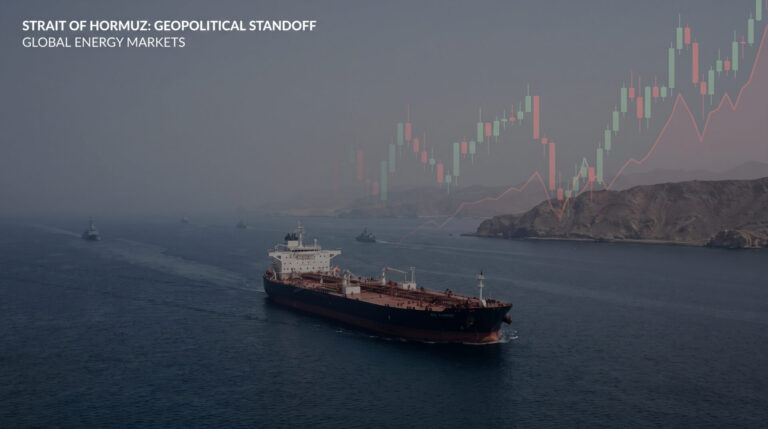
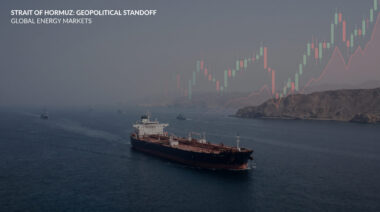
The current US-Iran conflict has again turned the Strait of Hormuz into the central fault line for global markets. Iran’s message is that the waterway will stay closed until Washington changes its behaviour, while the US position remains rooted in heavier economic pressure and deterrence. Since the last de-escalation deal, oil had briefly lost some of its geopolitical premium as traders assumed a lower probability of shipping disruption, but that calm has reversed as the renewed stand-off reintroduced supply risk into crude markets. The escalation matters because this is not only a military or diplomatic story; it is also an inflation, shipping and portfolio-allocation story. When investors fear that energy flows could be disrupted, they typically move into a risk-off posture, reducing appetite for cyclical sectors and becoming more defensive across global equities. That is why stock markets from Asia to Europe to the US have become more sensitive to headlines around tanker access, sanctions and retaliatory threats.
The latest developments show a conflict that is widening in message even when the battlefield remains fragmented. Iran has said the Strait of Hormuz will remain shut until the US changes course, warned neighbouring Gulf states against joining the American sanctions campaign, and suggested that any additional US action could trigger a much broader regional response. Tehran has also indicated that it may selectively allow essential shipments, as seen in reports of limited tanker access for Iraq, while at the same time stressing higher defence readiness and stronger domestic weapons production. Washington, by contrast, has kept its language centred on stronger sanctions, pressure and compliance demands through official government channels (U.S. Department of State, U.S. government overview). The broader Middle East picture adds to the anxiety: Israeli military activity remains active across multiple fronts, and the humanitarian situation in Gaza continues to deteriorate, which means the crisis is being priced not as a single bilateral confrontation but as a wider regional risk event.
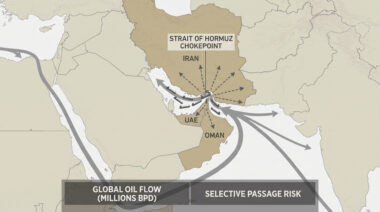
The next phase will likely be decided less by one dramatic statement and more by whether sanctions, maritime restrictions and retaliatory signalling begin to create durable economic damage. US sanctions matter because they do not only target Iranian revenues; they can also affect shipping finance, insurance, settlement channels and the willingness of counterparties to engage, all of which increases pressure on the Iranian economy and narrows Tehran’s room for manoeuvre (U.S. Department of State, U.S. government overview). Iran’s answer has been to raise the cost of pressure by threatening disruption in the Gulf, warning neighbouring states, and keeping the possibility of a broader escalation alive. For markets, the key issue is whether both sides remain within a coercive-but-contained pattern or slip into actions that materially interrupt energy transit. The rest of the world is trying to prevent that outcome through diplomacy, de-escalation appeals, shipping-security coordination and humanitarian pressure, but until there is a credible path back to negotiations, investors are likely to keep pricing a geopolitical risk premium into oil and other sensitive assets.
A closure or even a prolonged restriction in the Strait of Hormuz matters because it threatens one of the world’s most important oil transit chokepoints. Oil does not need to stop flowing completely for prices to react; the mere fear of delayed cargoes, higher tanker insurance, longer shipping routes and tighter near-term availability can be enough to push crude higher. In the near future, price direction will likely depend on four questions: how long restrictions last, whether selective tanker movement continues, whether other producers can offset supply concerns, and whether the confrontation spills into a wider regional conflict. If the closure persists, the first market response is usually a higher crude-risk premium, followed by pressure on freight costs and inflation expectations. If diplomacy gains traction and shipping resumes more normally, some of that premium can unwind quickly. In other words, oil is likely to stay headline-driven, with volatility reacting not only to physical disruption but also to every signal about sanctions, retaliation and the security of Gulf energy routes.
The impact on world stock markets is likely to stay uneven, because higher oil prices and higher uncertainty do not hit all economies or sectors in the same way.
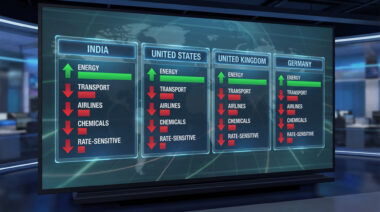
In India, the most vulnerable areas are usually sectors exposed to imported energy costs, fuel-intensive operations and margin pressure, including airlines, logistics, chemicals, paints, and parts of consumer demand that benefit from softer inflation. If crude stays elevated, investors may also worry about inflation persistence, a wider import bill and the possibility of delayed rate relief, which can weigh on rate-sensitive segments.
In the US, the most exposed sectors are often transport, airlines, chemicals, broader industrial users of fuel, and consumer-facing businesses if energy prices begin to erode purchasing power; energy-linked segments can act as a relative buffer, but the wider index still becomes more volatile when inflation expectations rise.
In Europe, the UK market may see some cushioning from energy exposure, while Germany is more vulnerable through manufacturing, chemicals, transport and export-linked industry that depends on predictable input costs.
Across all three regions, the biggest equity risk is not only cost inflation but also uncertainty: when oil stays volatile, investors reduce risk, reprice growth expectations and rotate toward defensives.
The market logic of the 2026 conflict cycle is straightforward even without attaching unsupported point moves to every episode. When the war first escalated in February 2026, oil reacted by rebuilding a risk premium as traders priced in the possibility of disrupted Gulf supply, while stock markets globally moved into a more defensive stance and sector rotation intensified.
When hostilities eased in mid-July 2026, that premium partially unwound: crude cooled, transport and consumption-sensitive sectors found relief, and broader equity sentiment improved because investors began to price a lower probability of supply disruption.
But when the conflict flared again at the end of July 2026, oil once more started reacting to the possibility that the Strait of Hormuz could become an active pressure point rather than a rhetorical one.
That renewed move matters because the market is no longer reacting to a first shock; it is reacting to the idea that the conflict can stop and restart quickly, which tends to keep volatility higher for longer. For investors, the core takeaway is simple: as long as Hormuz remains unstable, oil, inflation expectations and global equity sentiment are likely to remain tightly linked.
Related Tags


 IIFL Customer Care Number
(Gold/NCD/NBFC/Insurance/NPS)
1860-267-3000 / 7039-050-000
 IIFL Capital Services Support WhatsApp Number
+91 9892691696
Download The App Now


Follow us on


2026, IIFL Capital Services Ltd. All Rights Reserved

IIFL Capital Services Limited - Stock Broker SEBI Regn. No: INZ000164132 (Member ID - NSE: 10975 BSE: 179 MCX: 55995 NCDEX: 01249), DP SEBI Reg. No. IN-DP-185-2016, PMS SEBI Regn. No: INP000002213, IA SEBI Regn. No: INA000000623, Merchant Banker SEBI Regn. No. INM000010940, RA SEBI Regn. No: INH000000248, BSE Enlistment Number (RA): 5016, AMFI-Registered Mutual Fund Distributor & SIF Distributor
ARN NO : 47791 (Date of initial registration – 17/02/2007; Current validity of ARN – 08/02/2027), PFRDA Reg. No. PoP 20092018, IRDAI Corporate Agent (Composite) : CA1099

This Certificate Demonstrates That IIFL As An Organization Has Defined And Put In Place Best-Practice Information Security Processes.