
2 Nov 2026 , 05:48 PM

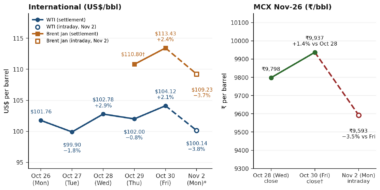
Prices for Crude oil is fell sharply on Monday, November 2, as talks aimed at ending the US-Israeli war with Iran raise hopes of reopening the Strait of Hormuz. Brent January futures were down about 3.7% at $109.23 a barrel in early trade, having settled at $113.43 on Friday. The US West Texas Intermediate fell about 3.8% to $100.14 a barrel. On India’s Multi Commodity Exchange (MCX), the November 2026 crude contract was trading near ₹9,593 per barrel, down roughly 3.5% in the morning session.
However, it is important to note that the talks are being mediated by Qatar and coordinated with Washington, but Iran says it is not holding direct negotiations with the United States. Monday’s figures are intraday, not closing prices, and the session was still under way when this report was prepared.
The decline reverses a strong run. Brent rose 13.6% in October and WTI 15.2%, a fourth straight monthly gain, as tanker attacks in the Strait of Hormuz and Houthi strikes on Saudi Arabia pushed both benchmarks to their highest settlements since late April’26. The central question for investors is whether diplomacy can unwind a premium built on physical disruption, or whether the shortfall in barrels keeps prices elevated even if talks succeed.

Recent Price Action: The Last Five Sessions
The chart and table below trace the most recent settlement data alongside Monday’s intraday moves. Brent is shown on the January contract, which became the front month after the December contract expired on Friday at $117.64. That expiry explains why some reports cite a higher Friday Brent figure.
Why Crude Is Falling Despite Still Trading Above $100
A two-day reopening plan on the table: Iran’s foreign minister said Qatari mediators helped cut Tehran’s seven-day plan to two days: US measures on day one, with normal navigation through Hormuz restored on day two. He also said no conclusion had been reached, and the plan depends on US compliance with Iranian conditions.
Talks without direct US contact, but a softer tone: Iran says no direct talks with Washington are taking place. Its security chief described a letter from Vice President JD Vance as a markedly changed tone from the US side, which he called a positive sign.
Strike risk has eased, for now: US Secretary of State Marco Rubio said President Trump had not decided whether to order further strikes and would prefer a diplomatic settlement. A weekend without major military escalation has also taken some immediate pressure off prices, according to market analysts quoted by Reuters.
A political split over timing: Axios reported that Israeli Prime Minister Benjamin Netanyahu is pressing Trump to strike Iran soon after Tuesday’s midterm elections, while Trump wants negotiations to play out. That tension is why the decline may prove fragile.
Part of the rally was risk premium: Market commentary attributes part of last week’s gains to a geopolitical risk premium, the extra margin built into prices for the chance that barrels will be lost. That premium is the part most sensitive to diplomatic headlines.
The Peace Premium Puzzle, Explained
Oil in this conflict is priced on two layers. The first is physical: barrels that cannot reach the market. The second is a risk premium on top, paid for the possibility that more barrels are lost. Diplomatic news moves the second layer quickly, but it cannot repair the first overnight. That is why a 3.7% fall still leaves Brent near $109, well above the $72 a barrel it traded at in late February, before the war began.
The physical squeeze is measurable. Kpler data reported by CNBC showed crude shipments through Hormuz at 9.4 million barrels per day in the week ended October 14, about 70% of the pre-war average, after touching pre-war levels in September. Transit and flow estimates have varied widely since then, and no single measure gives a complete picture. ADNOC’s chief executive has said the world has drawn one billion barrels from inventories since the war disrupted shipping through the strait. Those stocks must be rebuilt, which puts a floor under prices even after a deal.
The implication is an asymmetric market. A verified reopening would strip out the risk premium and could push prices lower quickly. But a depleted inventory base and slow recovery in Gulf output would keep the market tight for months, while a breakdown in talks could restore the premium within a session. That is why the market is trading on headlines, and why headlines can reverse so fast.
Why Crude Oil Matters Beyond the Headlines
Inventories are the shock absorber: With a billion barrels drawn down, the rebuilding of stocks becomes a source of demand that outlasts any ceasefire. That restocking is the main reason analysts are reluctant to forecast a rapid collapse in prices.
OPEC+ has limited leverage: The seven core members agreed on Sunday, November 1, to hold December output targets unchanged, at a combined 30.9 million barrels per day. Reuters reported that the decision ratifies quotas Gulf members cannot physically reach while Hormuz remains constrained. Rystad Energy’s Jorge Leon has said the group has “very limited power over the physical oil market”.
The UAE has left OPEC: The UAE quit the organisation in May, so monthly output decisions now come from the seven core members rather than the full group. A full 21-country ministerial meeting is due on November 29 to set 2027 quotas.
Diesel is the tightest pinch: The International Energy Agency’s October report warned that constraints in diesel markets could continue well into next year, with fresh attacks on Saudi Arabia threatening to slow the supply recovery.
Europe’s energy bill is rising: German Chancellor Friedrich Merz said the conflict had added more than €100 billion ($112 billion) to Europe’s energy costs and urged a negotiated settlement.
Global Market Context
Forecasters have been revising their numbers upward. Goldman Sachs’ October 12 note raised its December 2026 Brent forecast to $90 a barrel from $85 and kept its 2027 average at $80. It said Brent could fall into the $60s if Gulf output recovers faster than expected, but its severe-disruption scenarios reach $120 or more. Those are conditional scenarios rather than the bank’s base case, and the spread between them shows how wide the range of outcomes has become.
The calendar is crowded. US midterm elections take place on Tuesday, November 3, and Iran’s army spokesman has warned that any renewed war could extend beyond the Middle East and last longer than the previous conflict. Analysts expect OPEC+ to face an extremely difficult decision on 2027 output, given uncertainty over the war, the pace of recovery through Hormuz, and the size of the surplus that could emerge once disrupted barrels return.
The structure of the market has changed too. Oil that was in surplus before the war is now in deficit, and that deficit is being covered by drawing down stocks rather than by new supply. Until the flows return, the market’s sensitivity to any single headline remains unusually high.
MCX Crude and India: What It Means
India meets 88.7% of its crude requirement through imports, according to 2025-26 data cited by WION. That makes every move in global prices a direct question for the rupee, inflation, and the fiscal account.
Import bill: India’s crude import bill rose 46.3% to $90.6 billion in the first half of the current fiscal year, while import volumes stayed flat. Government data cited by Oilprice.com put the Indian crude import price at an average of $121.25 a barrel for October so far, as of late October. This week’s fall gives only partial relief.
Rupee: The rupee closed at about ₹95.05 per dollar on October 15 (WION) and was near ₹94.9 on Monday. Lower crude reduces the dollar demand from oil importers, which supports the currency. A firmer rupee then trims the rupee price of crude, which is why good returns cited the currency as adding downward pressure on MCX this morning.
How MCX prices crude: MCX crude tracks global benchmarks converted into rupees, so moves in dollar crude and in the exchange rate compound. The November 2026 contract, which expires on November 19 with a lot size of 100 barrels, is the front month.
Fuel prices and policy: India cut fuel import taxes in March to protect consumers from the war’s energy shock (Al Jazeera, Mar 27). Whether pump prices move now depends on government and oil marketing company decisions, and no new pump-price decision appeared in the sources reviewed.
Inflation: Fuel and freight costs feed into consumer prices across the economy. A sustained fall in crude would ease that pressure, while a rebound would reintroduce it.
Which Companies and Sectors Are in Focus
Falling crude helps some Indian businesses and hurts others. The impacts below reflect how each business is structured. We did not verify share-price moves for these companies on Monday, and nothing here is an investment recommendation.
Positive impact expected on:
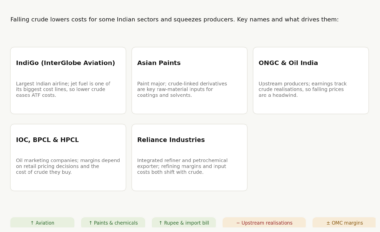
Aviation — jet fuel is one of the largest costs for airlines such as IndiGo, so lower crude feeds quickly into operating costs.
Paints and specialty chemicals — crude-linked solvents and derivatives make up a large share of input costs for companies such as Asian Paints
Import-heavy businesses — a smaller oil import bill reduces currency pressure and eases the macro backdrop for importers more broadly.
Negative or mixed impact on:
Upstream producers — ONGC and Oil India earn more per barrel when crude prices are high, so a fall reduces revenue per barrel.
Oil marketing companies — IOC, BPCL and HPCL typically gain when crude costs fall and pump prices are held, but the net effect depends on pricing decisions.
Integrated refiners — Reliance Industries’ exposure is mixed since refining margins and input costs both move with crude.
What Investors Are Watching Next
The two-day reopening plan: Whether Washington accepts Iran’s conditions, and whether ships resume passage through Hormuz. Iran has said it will not reopen the strait before its conditions are met.
The US midterms and the strike decision: The result on Tuesday, November 3, could shape Trump’s choice on further strikes. He has not yet decided, according to Secretary of State Rubio.
Tanker security: Attacks on tankers are raising shipping and insurance costs. Iran’s navy has claimed another tanker caught fire after striking mines east of the strait, a claim that no maritime authority has yet confirmed.
Weekly US inventory data: The EIA’s latest reported figure showed commercial crude stocks down 1.9 million barrels to 410.6 million for the week ended October 23. Consecutive draws would reinforce the tightness argument.
The OPEC+ ministerial meeting on November 29: The decision on 2027 quotas will set the baseline for the post-war supply path.
India’s monthly import data and the rupee: Signs of how much of October’s price spike is feeding through to the import bill, and whether the rupee holds its recent firmness.
Short-Term Outlook and Risks
Crude is trading on headlines for now, and the near-term direction depends on whether the two-day plan becomes a working reopening. If shipping through Hormuz recovers in a verifiable way, the risk premium could unwind further, and prices could fall faster than they rose. Even so, the inventory drawdown, the uncertain capacity outlook for OPEC+ members, and the slow return of Gulf output argue against a quick return to pre-war levels.
The risks run both ways. Talks could stall, the midterm result could embolden strikes, and fresh attacks on tankers or Saudi infrastructure could reverse this week’s decline in a single session. Iran has warned that any new attack would trigger a broad response against US and Israeli targets in the region. Without a signed arrangement, the market will keep pricing headlines.
So, can supply risks keep prices elevated? For now, yes. Even if talks progress, the physical shortfall and the inventory hole mean crude is likely to stay well above its pre-war level. Whether it remains above $100 will depend less on the next headline from Doha and more on whether Hormuz traffic recovers over the coming weeks.
Disclaimer – The stock/s and indices mentioned in this article are discussed solely for informational and educational purposes. It should not be construed as investment advice or a recommendation to buy or sell any securities. The views and investment recommendations mentioned in the article are reported by investment experts, analysts, broking houses, rating agencies and other market professionals in their own capability and do not represent the views of Indiainfoline/IIFL Capital website or its management. Investors should conduct their own research or consult a financial advisor before making any investment decisions. Investments in securities markets are subject to market risks. Read all the related documents carefully before investing.
Related Tags


 IIFL Customer Care Number
(Gold/NCD/NBFC/Insurance/NPS)
1860-267-3000 / 7039-050-000
 IIFL Capital Services Support WhatsApp Number
+91 9892691696
Download The App Now


Follow us on


2026, IIFL Capital Services Ltd. All Rights Reserved

IIFL Capital Services Limited - Stock Broker SEBI Regn. No: INZ000164132 (Member ID - NSE: 10975 BSE: 179 MCX: 55995 NCDEX: 01249), DP SEBI Reg. No. IN-DP-185-2016, IA SEBI Regn. No: INA000000623, Merchant Banker SEBI Regn. No. INM000010940, RA SEBI Regn. No: INH000000248, BSE Enlistment Number (RA): 5016, AMFI-Registered Mutual Fund Distributor & SIF Distributor
ARN NO : 47791 (Date of initial registration – 17/02/2007; Current validity of ARN – 08/02/2027), PFRDA Reg. No. PoP 20092018, IRDAI Corporate Agent (Composite) : CA1099

This Certificate Demonstrates That IIFL As An Organization Has Defined And Put In Place Best-Practice Information Security Processes.