



The Indian Rupee stayed near record lows during the week despite repeated RBI interventions, as rising Brent crude prices, geopolitical uncertainty, and foreign fund outflows continued to pressure the currency. Markets now await crude movements and upcoming capital inflows for direction.
Read More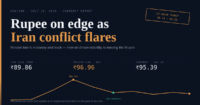

The Indian Rupee stayed near record lows during the week despite repeated RBI interventions, as rising Brent crude prices, geopolitical uncertainty, and foreign fund outflows continued to pressure the currency. Markets now await crude movements and upcoming capital inflows for direction.
The rupee's recovery has unravelled as escalating tensions in the Middle East, higher oil prices, and a widening trade deficit push the currency back toward record lows. The analysis explores the RBI's intervention strategy, inflation risks, and why India's dependence on imported crude remains its biggest structural vulnerability.
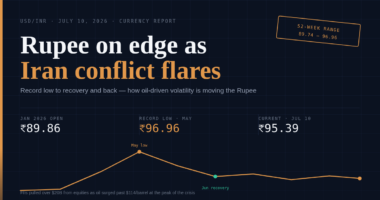
The Indian Rupee has swung between record lows and sharp recoveries in 2026 as geopolitical tensions, crude oil prices, RBI intervention, and foreign investor flows continue to shape the currency's outlook.
The Indian rupee has weakened amid persistent US dollar strength, corporate dollar demand, and arbitrage activity between onshore and offshore markets. While lower crude oil prices and RBI intervention have limited the decline, investors remain focused on upcoming Federal Reserve decisions and US inflation data to gauge the rupee's next move.
The Indian rupee climbed to 94.49 against the US dollar, its strongest level in seven weeks, after a US-Iran peace agreement triggered a sharp decline in global oil prices. With India heavily dependent on imported crude, lower energy costs are easing pressure on the current account deficit, supporting the currency, and improving the outlook for inflation and monetary policy. Investors are now watching whether the peace deal is formally signed and whether oil prices continue to trend lower.
The Indian rupee strengthened to 95.20 against the US dollar on Monday as optimism over a possible US-Iran peace agreement, falling crude oil prices, and progress in India-US trade negotiations boosted market sentiment. Investors are now closely watching the RBI’s $5 billion USD/INR swap auction scheduled this week.
NCDEX is expanding beyond agricultural commodities with NDEX and FINNDEX, two rule-based equity indices that will track large Indian companies and financial sector stocks. The exchange plans to introduce ETFs and mutual funds linked to the indices, followed by futures and options, subject to approvals and market readiness.
Indian stock markets ended lower for the third consecutive session on October 22, with the Sensex declining 460 points and the Nifty slipping below 22,700. Media, FMCG, IT and energy stocks led sectoral losses, while rising Brent crude prices and a sell-off across Asian markets added to investor concerns.
Sensex fell 876 points to 73,852.90 and Nifty declined 1.11% to 22,888.95 on October 19, 2026. Banking and IT stocks led losses amid earnings concerns, elevated crude oil prices and foreign investor outflows.
NSE IFSC and the London Stock Exchange will explore cooperation in cross-border listings, derivatives, equity indices and market-data distribution under an MoU signed on October 13, 2026.
NCDEX is expanding beyond agricultural commodities with NDEX and FINNDEX, two rule-based equity indices that will track large Indian companies and financial sector stocks. The exchange plans to introduce ETFs and mutual funds linked to the indices, followed by futures and options, subject to approvals and market readiness.
Indian stock markets ended lower for the third consecutive session on October 22, with the Sensex declining 460 points and the Nifty slipping below 22,700. Media, FMCG, IT and energy stocks led sectoral losses, while rising Brent crude prices and a sell-off across Asian markets added to investor concerns.
Sensex fell 876 points to 73,852.90 and Nifty declined 1.11% to 22,888.95 on October 19, 2026. Banking and IT stocks led losses amid earnings concerns, elevated crude oil prices and foreign investor outflows.
NSE IFSC and the London Stock Exchange will explore cooperation in cross-border listings, derivatives, equity indices and market-data distribution under an MoU signed on October 13, 2026.


 IIFL Customer Care Number
(Gold/NCD/NBFC/Insurance/NPS)
1860-267-3000 / 7039-050-000
 IIFL Capital Services Support WhatsApp Number
+91 9892691696
Download The App Now


Follow us on


2026, IIFL Capital Services Ltd. All Rights Reserved

IIFL Capital Services Limited - Stock Broker SEBI Regn. No: INZ000164132 (Member ID - NSE: 10975 BSE: 179 MCX: 55995 NCDEX: 01249), DP SEBI Reg. No. IN-DP-185-2016, IA SEBI Regn. No: INA000000623, Merchant Banker SEBI Regn. No. INM000010940, RA SEBI Regn. No: INH000000248, BSE Enlistment Number (RA): 5016, AMFI-Registered Mutual Fund Distributor & SIF Distributor
ARN NO : 47791 (Date of initial registration – 17/02/2007; Current validity of ARN – 08/02/2027), PFRDA Reg. No. PoP 20092018, IRDAI Corporate Agent (Composite) : CA1099

This Certificate Demonstrates That IIFL As An Organization Has Defined And Put In Place Best-Practice Information Security Processes.


