
22 May 2026 , 07:21 PM
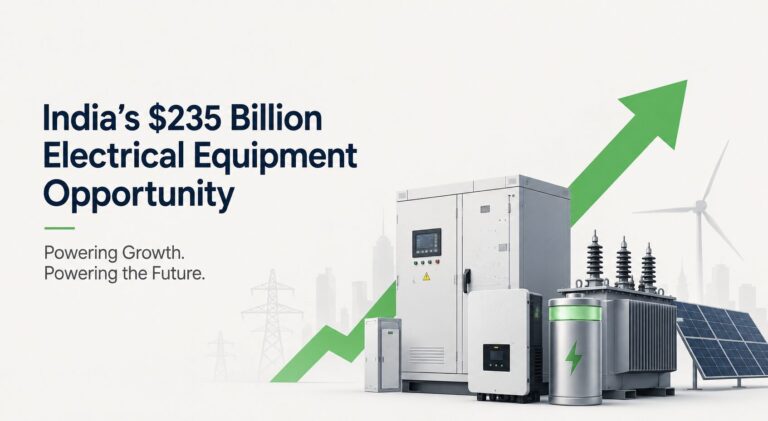
A new McKinsey & Company report dropped this week with a headline number that deserves to stop you in your tracks: India’s electrical equipment industry could scale from roughly $50 billion in production today to $195–235 billion by 2035. Exports could exceed $60 billion. The sector spanning power generation, solar modules, batteries, transmission systems, and power electronics could become one of the defining “Make in India” success stories of the decade. ‘Could’. That word is doing a lot of work here.
Because buried inside McKinsey’s optimism is a warning that should worry every policymaker, industrialist, and investor tracking India’s manufacturing ambitions: if the country simply rides current momentum without deliberate intervention, it won’t capture this opportunity, it will import it. And the consequences of that failure would be severe.
Let’s begin with what’s working. India’s electrical equipment market has already clocked impressive numbers. Domestic consumption reached $59 billion in FY2025, growing at a compound annual rate of 11% over the past five years. That’s not a fluke it reflects genuine structural tailwinds: rapid urbanisation, a booming renewable energy push, the early innings of an EV revolution, expanding data centre infrastructure, and a government committed to grid modernisation.
McKinsey projects this to continue. The industry is expected to grow at 11–13% annually through 2035, with domestic consumption potentially hitting $170–205 billion. The fastest-growing segments are assumed to be – storage systems, grid management, power electronics, and solar PVs, forecasted to expand at over 14% CAGR.
The global context adds further urgency. Electrification is accelerating worldwide. The shift away from over-reliance on China for critical hardware, the much-discussed “China+1” realignment is creating openings that didn’t exist five years ago. India has the engineering talent, the cost base, and increasingly the policy will to step into those gaps.
The global power electronics market alone could exceed $140 billion by 2035. Renewable energy equipment and high-end cables could represent a combined global opportunity of $350–400 billion. India is not a marginal player in this story, it has the potential to become a central one.
Here’s where the report gets uncomfortable.
India’s import dependence in electrical equipment has risen – not fallen; from 22% in FY2020 to 33% in FY2025. That’s the opposite direction. And under a business-as-usual scenario, McKinsey warns this figure could exceed 70% by 2035, creating a production shortfall of more than $130 billion. To put that in perspective: the report explicitly flags that electrical equipment imports, left unchecked, could eventually rival India’s oil and gas import bill in scale. That’s not a manufacturing challenge. That’s a strategic vulnerability.
The most striking example is power electronics segment like inverters, converters, and modules that sit at the heart of EV charging, solar systems, and grid infrastructure. Today, India imports $4.7 billion worth of power electronics annually, with domestic production under $400 million. Import dependence in this segment exceeds 90%. Yet by 2035, domestic demand for power electronics could exceed $17 billion. Without a manufacturing response, nearly all of that demand gets shipped in from abroad and primarily from China.
Batteries tell a similar story. Demand is growing at roughly 15% CAGR. Import dependence remains above 60%. Solar PV, despite India’s stated ambitions, it still imports around 40% of its modules. The domestic value chain from silica mining to wafers to cells to modules remains thin and fragmented.
McKinsey’s prescription is direct: India must expand domestic manufacturing capacity nearly five times from current levels. That’s not incremental improvement, it’s a structural transformation. The priority segments are clear. Power electronics needs to go from sub-$400 million in production to $7 billion by 2035. Batteries need domestic lithium-ion cell manufacturing at scale, with PLI-linked capacity expanded meaningfully. The solar value chain needs strengthening at every link — not just at the module assembly end, which is where most current investment is concentrated.
The export opportunity is equally compelling, and equally underexploited. India’s electrical equipment exports reached $12 billion in FY2024, led by solar equipment, cables, switchgears, and generators. But in a global market worth $500 billion, India holds less than 2% share while China commands nearly 30%. The gap is not explained by lack of demand for Indian goods. It reflects gaps in cost competitiveness, technology depth, and export infrastructure.
Here, the report identifies two areas where India has a genuine edge: power software and engineering talent. The global power software market is a fast-growing opportunity where India’s software capabilities and lower cost base could create real competitive advantage, if industry and policy move in concert. Another number in the report that deserves attention is spending on R&D, because it signals a deeper problem. Indian electrical equipment manufacturers spend less than 0.5% of revenue on R&D. Their Chinese counterparts, however, spend 1.5–2%. That gap sustained over years and decades is how technology leadership is lost quietly, before anyone realises it’s gone.
McKinsey draws a comparison that India’s industry should take seriously: IT services and auto components. In both sectors, India started from a position of relative weakness, built capability through a combination of policy support, entrepreneurial ambition, and sustained investment, and eventually emerged as a globally respected player.
The electrical equipment sector has analogous potential. The domestic market is large and growing. The global tailwinds are strong. The “China+1” moment is real. India has the engineers. It has the policy framework — PLI schemes, domestic content requirements, infrastructure investment.
What it doesn’t yet have is the urgency.
The next decade will determine whether India becomes a major exporter of the equipment that powers the world’s clean energy transition or whether it becomes one of the world’s largest importers of it. Those are not equally acceptable outcomes. One builds industrial capacity, creates skilled jobs, and strengthens energy security. The other hollows out domestic capability at the very moment global demand is peaking.
India has been here before at inflection points where bold action produced lasting advantage. The electrical equipment sector is offering another such moment.
The question, as always, is whether the country will take it.
Based on McKinsey & Company’s report “Wired for Growth: India’s Electrical Equipment Opportunity” (May 2026).
Related Tags


 IIFL Customer Care Number
(Gold/NCD/NBFC/Insurance/NPS)
1860-267-3000 / 7039-050-000
 IIFL Capital Services Support WhatsApp Number
+91 9892691696
Download The App Now


Follow us on


2026, IIFL Capital Services Ltd. All Rights Reserved

IIFL Capital Services Limited - Stock Broker SEBI Regn. No: INZ000164132 (Member ID - NSE: 10975 BSE: 179 MCX: 55995 NCDEX: 01249), DP SEBI Reg. No. IN-DP-185-2016, IA SEBI Regn. No: INA000000623, Merchant Banker SEBI Regn. No. INM000010940, RA SEBI Regn. No: INH000000248, BSE Enlistment Number (RA): 5016, AMFI-Registered Mutual Fund Distributor & SIF Distributor
ARN NO : 47791 (Date of initial registration – 17/02/2007; Current validity of ARN – 08/02/2027), PFRDA Reg. No. PoP 20092018, IRDAI Corporate Agent (Composite) : CA1099

This Certificate Demonstrates That IIFL As An Organization Has Defined And Put In Place Best-Practice Information Security Processes.