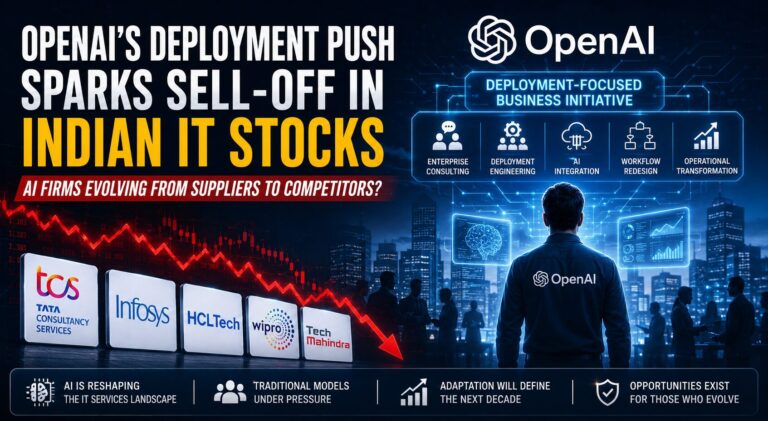
Shares of major Indian IT companies including Tata Consultancy Services, Infosys, HCLTech, Wipro, and Tech Mahindra came under pressure after the announcement surrounding OpenAI’s new deployment-focused business initiative.
While the announcement itself did not immediately alter the revenue outlook for Indian IT firms, the market reaction highlighted a deeper concern: investors increasingly fear that AI companies may evolve from being technology suppliers into direct competitors to traditional IT services providers.
The sharp reaction reflects a broader reassessment of how generative AI could reshape the global outsourcing and consulting industry over the next decade.
Historically, the relationship between AI firms and IT service companies appeared complementary.
AI companies such as OpenAI provided foundational models and tools, while IT service firms handled enterprise implementation, integration, customization, and deployment.
However, the latest deployment-focused strategy signals that OpenAI may now be moving further up the enterprise value chain. Instead of merely supplying AI technology, OpenAI is increasingly positioning itself around:
These areas represent some of the most profitable and strategically important revenue streams for global IT service providers.
For investors, the concern is straightforward: if AI firms begin directly servicing enterprises, traditional IT vendors could lose part of their role in large-scale digital transformation projects.
One of the biggest triggers for the market reaction was OpenAI’s emphasis on embedded engineering teams working closely within client organizations. This operating model resembles the long-established delivery structure used by major IT consulting firms and outsourcing companies. Companies such as Tata Consultancy Services, Infosys, HCLTech, Accenture, and Cognizant have traditionally generated billions of dollars through services such as:
The fear is that AI-native deployment teams could simplify or automate significant portions of these projects. If generative AI reduces coding effort, automates testing, shortens deployment cycles, and improves operational efficiency, enterprises may require:
That directly threatens the labor-intensive outsourcing model that has historically powered Indian IT growth.
For decades, Indian IT companies benefited from labor arbitrage, a model built around large offshore engineering teams delivering cost-efficient services to global enterprises. But generative AI is fundamentally altering that equation. AI systems are increasingly capable of automating:
As productivity rises, enterprises may no longer require the same scale of manpower-based contracts. This creates a difficult long-term question for investors: if fewer employees are needed to deliver the same amount of work, how will traditional IT firms sustain revenue growth under existing billing models?
OpenAI’s deployment expansion reinforced this narrative because it suggests that AI implementation itself may gradually become more productized and automated.
Another important factor behind the selloff was OpenAI’s growing alignment with global consulting and transformation firms. Partnerships involving companies such as McKinsey & Company, Capgemini, and Bain & Company indicate that enterprise AI deployment may increasingly combine:
This raises fears that AI-native ecosystems could capture higher-margin strategic transformation work, while traditional outsourcing firms risk being pushed toward lower-margin execution roles.
For Indian IT companies, the concern is not merely technological disruption, it is more focused on value-chain displacement.
Indian equity markets are particularly sensitive to developments affecting the technology outsourcing sector. The IT industry carries significant weight in indices such as the NIFTY 50 and NIFTY IT, while many large Indian IT firms derive a substantial share of their revenues from US and European enterprises.
As a result, even the perception of structural disruption can trigger immediate repricing in stock valuations. Investors are also struggling with a broader uncertainty surrounding AI monetization. Most major Indian IT companies have already announced partnerships and AI initiatives involving firms such as:
However, markets remain unsure whether AI-driven productivity gains will ultimately:
This uncertainty explains why investor reactions remain highly sensitive to announcements from AI companies.
Not necessarily. Despite the market reaction, Indian IT firms continue to possess several major structural advantages, including – deep enterprise relationships, global delivery infrastructure, large-scale execution capabilities, regulatory and compliance expertise, cybersecurity integration, industry-specific operational knowledge and more.
Large enterprises managing mission-critical systems may still prefer established technology partners with proven delivery capabilities rather than relying entirely on AI-native firms. Moreover, AI itself could create an entirely new wave of enterprise technology spending.
Organizations across industries now require:
This may generate significant long-term demand for implementation and transformation services — areas where Indian IT firms remain highly competitive.
Rather than eliminating IT services, AI may reshape how technology services are delivered. The future industry structure could evolve toward:
In this ecosystem, firms that adapt fastest to AI-led delivery models could continue to grow despite structural disruption. The challenge for Indian IT companies will be transitioning from scale-driven outsourcing toward AI-enabled consulting and transformation services.
The selloff in Indian IT stocks was ultimately driven more by future expectations than immediate earnings impact.
Markets interpreted OpenAI’s deployment initiative as a sign that AI companies no longer want to remain backend technology suppliers. Instead, they may increasingly seek a direct role in enterprise transformation, consulting, and implementation, businesses that have historically formed the foundation of India’s IT outsourcing success.
As a result, investors reacted by:
While the actual financial impact may take years to fully materialize, the announcement served as a reminder that the AI revolution is beginning to reshape not only software development, but also the global IT services industry itself.
Disclaimer – The stock/s and indices mentioned in this article is discussed solely for informational and educational purposes. It should not be construed as investment advice or a recommendation to buy or sell any securities. Investors should conduct their own research or consult a financial advisor before making any investment decisions. Investments in securities market are subject to market risks. Read all the related documents carefully before investing.
Related Tags


 IIFL Customer Care Number
(Gold/NCD/NBFC/Insurance/NPS)
1860-267-3000 / 7039-050-000
 IIFL Capital Services Support WhatsApp Number
+91 9892691696
Download The App Now


Follow us on


2026, IIFL Capital Services Ltd. All Rights Reserved

IIFL Capital Services Limited - Stock Broker SEBI Regn. No: INZ000164132 (Member ID - NSE: 10975 BSE: 179 MCX: 55995 NCDEX: 01249), DP SEBI Reg. No. IN-DP-185-2016, IA SEBI Regn. No: INA000000623, Merchant Banker SEBI Regn. No. INM000010940, RA SEBI Regn. No: INH000000248, BSE Enlistment Number (RA): 5016, AMFI-Registered Mutual Fund Distributor & SIF Distributor
ARN NO : 47791 (Date of initial registration – 17/02/2007; Current validity of ARN – 08/02/2027), PFRDA Reg. No. PoP 20092018, IRDAI Corporate Agent (Composite) : CA1099

This Certificate Demonstrates That IIFL As An Organization Has Defined And Put In Place Best-Practice Information Security Processes.