China Index – Shanghai Composite – 4,110.81 | +0.11%
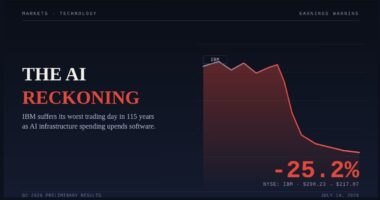
Shanghai ended the session marginally in the green, recovering from Tuesday’s sharp -1.64% sell-off driven by the tech-led global rout. Progress in US-Iran peace negotiations helped increase traffic through the Strait of Hormuz, easing pressure on global energy supplies and reducing inflation concerns, providing a mild floor under sentiment even as global technology stocks remained under pressure from concerns about AI spending sustainability.
Japan Index – Nikkei 225 – 69,174.75 | -613.63 | -0.88%
Tokyo extended its losing streak for a second consecutive session, weighed down by continued fallout from Wall Street’s technology sell-off. The Nikkei 225 fell further as a technology-driven sell-off on Wall Street weighed on sentiment, with growing concerns over heavy AI spending by hyperscalers driving the decline. Among notable fallers, Fujikura dropped 2.7%, Tokyo Electron lost 2.2%, Furukawa Electric fell 1.7%, Disco Corp slipped 2.2%, and Sumitomo Electric declined 1.6%. The Bank of Japan’s Summary of Opinions from its June meeting showed policymakers generally favoured continuing interest rate hikes, citing underlying inflation moving closer to the 2% target while financial conditions remain supportive — adding a domestic policy headwind to the external technology pressure.
Indian Index – Nifty 50 – 24,021.65 | +197.55 | +0.83%
Indian benchmark indices staged a recovery from Tuesday’s expiry-day sell-off that had pushed the index below 24,000, with buying interest returning as global cues stabilised and oil prices held near recent lows. The Nifty 50 had closed at 23,824.10 on June 23, down 278.80 points, in a sharp expiry-day sell-off that broke below the critical 24,000 level, with IT and metal sectors leading the decline at -2.23% and -3.23% respectively. Wednesday’s bounce reflected a partial mean-reversion from that oversold close, aided by the broader Asian recovery in risk appetite.
South Korean Index – KOSPI – 8,471.02 | +267.18 | +3.26%
Seoul staged a powerful partial recovery following Tuesday’s historic crash, though the session told a complex story of early euphoria fading into afternoon caution. The KOSPI’s surge was driven by Samsung Electronics’ announcement of a 90 trillion won share buyback programme and SK Hynix’s initiation of the listing process for American Depositary Receipts on Nasdaq, both of which catalysed short-covering after the prior day’s devastation. The KOSPI had opened at 8,356.79, briefly extending to 8,543.68 before retreating as gains evaporated, with SK Hynix reversing sharply from early highs while Samsung held more steadily — the recovery more a positioning unwind than a fundamental re-rating.
Hong Kong Index – Hang Seng Index (HSI) 23,412.19 | +75.90 | +0.33%
Hong Kong managed a marginal gain, recovering slightly after Tuesday’s 1.8% decline. Notable movers on the positive side included Tencent, Knowledge Atlas, SMIC, and Xiaomi, reversing some of the losses from the prior session. Sentiment remained cautious overall as investors awaited Micron Technology’s earnings after the US close, which were widely seen as the session’s most critical pending catalyst for chip-related stocks across the region.
Impact on India: The KOSPI’s June 23 crash is a cautionary case study in index concentration risk that Indian market regulators and investors should study closely. The Nifty 50’s own top five constituents — Reliance Industries, HDFC Bank, ICICI Bank, Infosys, and Bharti Airtel — account for a combined weight of approximately 35-40%, meaningfully lower than the KOSPI’s 61.7% four-stock concentration. This gives India’s benchmark considerably more cushion against a single-sector shock. That said, SEBI’s ongoing monitoring of leveraged ETF products and derivatives market activity in India reflects an awareness of the same concentration risk that caught Seoul’s regulators off guard. The KOSPI crash also reinforces the systemic risk embedded in single-stock leveraged ETFs — a product category SEBI has so far kept tightly regulated in India, a decision that looks increasingly prudent in hindsight.
Impact on India: SK Hynix’s Nasdaq ADR listing plan — at $29 billion, one of the largest proposed technology listings of 2026 — will draw a direct comparison with India’s own semiconductor ambitions. Micron Technology’s Gujarat fab, now in early production ramp, and the broader India Semiconductor Mission are competing for the same pool of global technology capital that SK Hynix’s ADR will also target. For Indian policymakers, the message from Seoul is that state-backed semiconductor ecosystems need not just capital but also deep liquidity mechanisms — listed instruments that allow global investors to access the upside of domestic chip expansion. India’s path toward a Nasdaq-equivalent listing environment for its semiconductor players is still years away, but SK Hynix’s move provides a useful template.
Impact on India: The Bank of Japan’s continued hawkish lean has significant implications for Indian financial markets through the yen carry trade channel. As Japanese rates rise, the yen carry trade — where investors borrow cheaply in yen to invest in higher-yielding assets including Indian bonds and equities — becomes less attractive. Any sharp unwinding of yen carry positions triggers simultaneous selling across emerging market assets, including India, regardless of domestic fundamentals. The RBI is aware of this channel and monitors yen movements closely alongside dollar movements. For Indian bond markets, a world where both the Fed and the BoJ are on hiking paths is more challenging than one where only the Fed is hawkish — it reduces the pool of cheap global capital available to fund India’s current account deficit.
Impact on India: Micron’s earnings matter for India in a specific and direct way. Micron’s Gujarat semiconductor fabrication facility is now operational, and the company’s financial health and demand outlook directly determine the pace and scale of its India investment commitments. Strong Micron guidance would support the case for accelerated capacity expansion at the Gujarat fab, adding manufacturing employment, technology transfer, and supply chain depth to India’s nascent semiconductor ecosystem. Weak guidance or cautious commentary on memory demand would slow that investment cadence. Indian semiconductor policymakers are watching tonight’s Micron call as closely as any Seoul fund manager.
Impact on India: Wall Street’s tech-led sell-off has a differentiated impact on Indian markets by sector. Indian IT services stocks — TCS, Infosys, Wipro, HCL Tech — are directly linked to US technology capital expenditure sentiment, since their largest clients are the same hyperscalers whose AI spending sustainability is now being questioned. When US technology valuations compress on concerns about AI return on investment, Indian IT stocks typically follow, as their revenue growth assumptions are tied to the same AI infrastructure buildout cycle. The Nifty IT sector’s -2.23% decline on June 23 is the clearest expression of this transmission. For the broader Nifty, the key question is whether the AI spending concern is a temporary valuation correction or a structural shift in the technology investment cycle — the answer will determine how long the IT sector drag on Indian markets persists.
Related Tags


 IIFL Customer Care Number
(Gold/NCD/NBFC/Insurance/NPS)
1860-267-3000 / 7039-050-000
 IIFL Capital Services Support WhatsApp Number
+91 9892691696
Download The App Now


Follow us on


2026, IIFL Capital Services Ltd. All Rights Reserved

IIFL Capital Services Limited - Stock Broker SEBI Regn. No: INZ000164132 (Member ID - NSE: 10975 BSE: 179 MCX: 55995 NCDEX: 01249), DP SEBI Reg. No. IN-DP-185-2016, IA SEBI Regn. No: INA000000623, Merchant Banker SEBI Regn. No. INM000010940, RA SEBI Regn. No: INH000000248, BSE Enlistment Number (RA): 5016, AMFI-Registered Mutual Fund Distributor & SIF Distributor
ARN NO : 47791 (Date of initial registration – 17/02/2007; Current validity of ARN – 08/02/2027), PFRDA Reg. No. PoP 20092018, IRDAI Corporate Agent (Composite) : CA1099

This Certificate Demonstrates That IIFL As An Organization Has Defined And Put In Place Best-Practice Information Security Processes.