13 Jul 2026 , 04:12 PM
South Korea’s benchmark KOSPI index witnessed a massive sell-off on Monday, falling nearly 9% as semiconductor stocks faced heavy selling pressure. The decline came amid rising geopolitical tensions, concerns over AI-driven valuations, and fears that the global memory chip cycle may be nearing its peak.
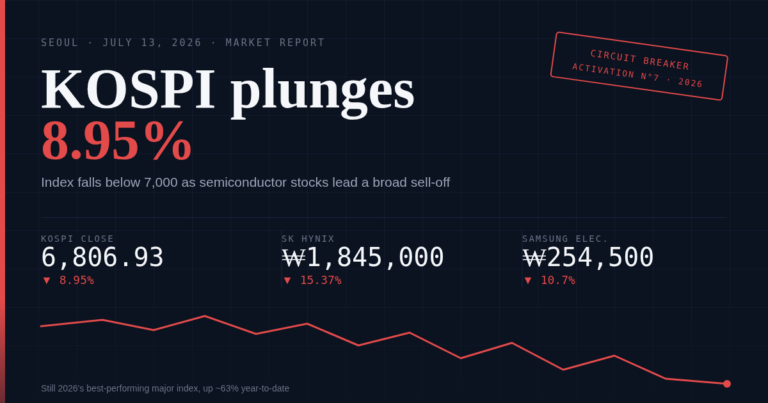
The KOSPI closed at 6,806.93, down 8.95% from the previous session, marking one of the sharpest single-day declines for the South Korean stock market in 2026.
The steep fall triggered the market’s 35th sell-side program trading curb and the seventh circuit breaker activation of the year.
Technology stocks were the biggest contributors to the market downturn, with major semiconductor companies witnessing aggressive selling.
Two of South Korea’s largest companies, SK hynix and Samsung Electronics, led the decline:
Together, SK hynix and Samsung Electronics account for more than 60% of KOSPI’s total market capitalization, making the index highly sensitive to movements in semiconductor stocks.
The sharp decline came despite the successful US debut of SK hynix’s American Depositary Receipts (ADRs).
SK hynix ADRs, listed under the ticker SKHY, closed at $168 on Friday, gaining 12.8% from the offering price of $149.
The listing became the largest US fundraising by a foreign company, surpassing Alibaba’s previous record.
However, the strong US market response failed to support SK hynix’s Seoul-listed shares. Analysts attributed the divergence to a “sell-the-news” reaction, with investors booking profits after the highly anticipated listing event.
The KOSPI sell-off was intensified by renewed geopolitical concerns involving the Middle East.
Reports of rising tensions between the US and Iran, including concerns surrounding the strategically important Strait of Hormuz, pushed crude oil prices higher and increased investor caution globally.
Higher oil prices raised concerns about:
The risk-off sentiment affected broader Asian markets, with several major indices also trading lower.
The weakness spread across Asian equities:
Investors moved cautiously as they assessed geopolitical risks, commodity price movements, and global monetary policy expectations.
The recent correction has intensified concerns over the sustainability of the AI-driven semiconductor rally.
South Korean chipmakers have been among the biggest beneficiaries of rising demand for:
However, investors are increasingly questioning whether AI-related investments have pushed semiconductor valuations ahead of underlying fundamentals.
Analysts noted that the market has become more sensitive to negative news and research reports due to the sharp rally witnessed in semiconductor stocks.
Despite the sharp correction, analysts said it may be too early to interpret the decline as the beginning of a semiconductor industry downturn.
Strong export data continues to support the sector outlook.
South Korea’s exports during the first 10 days of July:
Analysts believe that while memory chip prices and valuations require monitoring, there is limited evidence of a sharp collapse in semiconductor demand.
Technical factors also contributed to the decline.
Forced margin sales increased sharply, rising to:
Analysts expect additional pressure from delayed margin-related liquidations, which typically occur after investors fail to meet funding requirements.
The geopolitical uncertainty pushed crude oil prices higher:
Meanwhile, gold prices declined:
The rise in oil prices strengthened the US dollar and increased expectations that central banks may maintain tighter monetary policies.
Despite Monday’s sharp correction, the KOSPI remains the world’s best-performing major stock index in 2026.
The index is still up approximately 63% year-to-date, driven largely by the strong performance of AI-linked semiconductor stocks.
The recent decline highlights the risks of heavy market concentration in a few large technology companies and shows how quickly sentiment can shift in high-growth sectors.
Disclaimer – The stock/s and indices mentioned in this article is discussed solely for informational and educational purposes. It should not be construed as investment advice or a recommendation to buy or sell any securities. Investors should conduct their own research or consult a financial advisor before making any investment decisions. Investments in securities market are subject to market risks. Read all the related documents carefully before investing.
Related Tags


 IIFL Customer Care Number
(Gold/NCD/NBFC/Insurance/NPS)
1860-267-3000 / 7039-050-000
 IIFL Capital Services Support WhatsApp Number
+91 9892691696
Download The App Now


Follow us on


2026, IIFL Capital Services Ltd. All Rights Reserved

IIFL Capital Services Limited - Stock Broker SEBI Regn. No: INZ000164132 (Member ID - NSE: 10975 BSE: 179 MCX: 55995 NCDEX: 01249), DP SEBI Reg. No. IN-DP-185-2016, IA SEBI Regn. No: INA000000623, Merchant Banker SEBI Regn. No. INM000010940, RA SEBI Regn. No: INH000000248, BSE Enlistment Number (RA): 5016, AMFI-Registered Mutual Fund Distributor & SIF Distributor
ARN NO : 47791 (Date of initial registration – 17/02/2007; Current validity of ARN – 08/02/2027), PFRDA Reg. No. PoP 20092018, IRDAI Corporate Agent (Composite) : CA1099

This Certificate Demonstrates That IIFL As An Organization Has Defined And Put In Place Best-Practice Information Security Processes.