
14 May 2026 , 01:40 PM
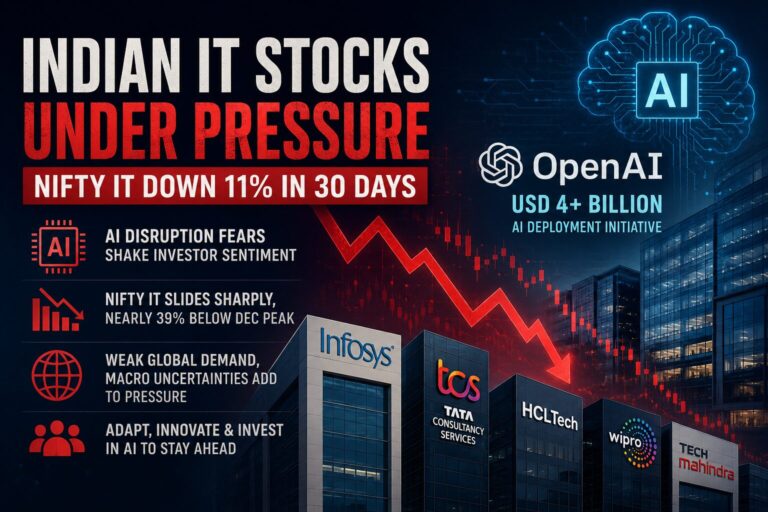
Indian IT stocks remained under heavy selling pressure for the fourth consecutive trading session as concerns over artificial intelligence-led disruption continued to weigh on investor sentiment. The sharp decline in the sector comes after OpenAI announced a major AI deployment initiative backed by more than USD 4 billion, raising fears that traditional IT outsourcing models may face structural disruption.
The correction has dragged the Nifty IT index sharply lower, with major companies such as Infosys, Tata Consultancy Services, HCL Technologies, Wipro, and Tech Mahindra witnessing steep declines over the past month.
The Nifty IT index has declined 11.44% over the last 30 days amid rising concerns over slowing global demand, weak discretionary spending, and increasing AI-led competition. The index had already fallen 3.7% on Tuesday to its lowest level since May 2023 following OpenAI’s announcement. On Wednesday, the index extended losses further by more than 1%, even as broader benchmark indices recovered from recent declines.
The latest correction has pushed Nifty IT nearly 39% below its December 2024 peak, reflecting significant derating across the sector.
Major IT stocks have witnessed sharp declines in the last one month:
Among Wednesday’s session losers were Coforge, Infosys, Tech Mahindra, and TCS, while Mphasis was the only Nifty IT constituent to close marginally higher.
Analysts believe investor concerns intensified after OpenAI announced plans to build a deployment-focused business capable of directly embedding AI engineers within enterprises.
OpenAI stated that its “forward deployed engineers” will work closely with organisations to redesign workflows, infrastructure, and operational systems around AI adoption.
Experts fear this model could bypass traditional Indian IT service providers in high-value consulting, deployment, and transformation projects.
The market is increasingly worried that AI-native firms may automate large portions of software implementation and enterprise consulting more efficiently, creating pricing pressure and margin compression for Indian IT companies.
Industry experts believe AI-native firms could significantly reshape how enterprises manage operations, customer engagement, software development, and decision-making by embedding intelligence directly into core business execution rather than functioning as standalone tools.
However, it is to be noted that Indian IT companies still possess strong advantages in:
Indian IT firms will need to aggressively invest in proprietary AI capabilities and process transformation tools to remain competitive.
Experts also warn that OpenAI’s expansion into workflow redesign threatens the traditional billable-hour model followed by large IT service firms. OpenAI’s acquisition of consulting firm Tomoro and its increasing focus on organisational transformation as key structural threats to the outsourcing industry.
Despite near-term concerns, analysts believe AI is unlikely to completely replace Indian IT companies. Instead, it may fundamentally restructure the sector.
Key expected industry changes include:
Market experts believe companies that adapt quickly to AI-led changes may continue to command premium valuations, while slower adopters could face prolonged pressure on growth and profitability.
Apart from AI disruption fears, weak global macroeconomic conditions are also weighing heavily on the India IT sector.
A recent report by HSBC noted that:
India’s IT industry, valued at nearly USD 315 billion (around ₹26.3 lakh crore), derives approximately 57% of its revenue from the US market, making the sector highly vulnerable to global economic slowdowns and changing technology spending trends.
The recent selloff in IT shares reflects growing investor cautioness around the future earnings trajectory of India’s technology sector. While AI-driven disruption remains a near-term concern, analysts believe the long-term outlook will depend on how effectively companies transition from traditional outsourcing models to AI-led digital transformation businesses.
Investors are expected to closely monitor:
for further direction in Nifty IT and major IT stocks.
Disclaimer – The stock/s and indices mentioned in this article is discussed solely for informational and educational purposes. It should not be construed as investment advice or a recommendation to buy or sell any securities. Investors should conduct their own research or consult a financial advisor before making any investment decisions. Investments in securities market are subject to market risks. Read all the related documents carefully before investing.
Related Tags


 IIFL Customer Care Number
(Gold/NCD/NBFC/Insurance/NPS)
1860-267-3000 / 7039-050-000
 IIFL Capital Services Support WhatsApp Number
+91 9892691696
Download The App Now


Follow us on


2026, IIFL Capital Services Ltd. All Rights Reserved

IIFL Capital Services Limited - Stock Broker SEBI Regn. No: INZ000164132 (Member ID - NSE: 10975 BSE: 179 MCX: 55995 NCDEX: 01249), DP SEBI Reg. No. IN-DP-185-2016, IA SEBI Regn. No: INA000000623, Merchant Banker SEBI Regn. No. INM000010940, RA SEBI Regn. No: INH000000248, BSE Enlistment Number (RA): 5016, AMFI-Registered Mutual Fund Distributor & SIF Distributor
ARN NO : 47791 (Date of initial registration – 17/02/2007; Current validity of ARN – 08/02/2027), PFRDA Reg. No. PoP 20092018, IRDAI Corporate Agent (Composite) : CA1099

This Certificate Demonstrates That IIFL As An Organization Has Defined And Put In Place Best-Practice Information Security Processes.