
For years, Rajesh Exports was regarded as one of India’s most remarkable corporate success stories. From a Bengaluru-based jewellery exporter, the company grew into a global gold refining powerhouse with revenues that frequently placed it among the country’s largest listed enterprises. Its international footprint, integrated business model, and association with the globally renowned Valcambi refinery helped build an image of scale and credibility.
That narrative is now facing its biggest challenge.
In an interim order issued on June 3, the Securities and Exchange Board of India (SEBI) barred Rajesh Exports and its promoter-chairman Rajesh Mehta from accessing the securities market, citing serious concerns over alleged financial misrepresentation, governance failures, and fund diversion. While the order is not a final determination of guilt, the scale of the allegations has sent shockwaves through India’s corporate and investment community.
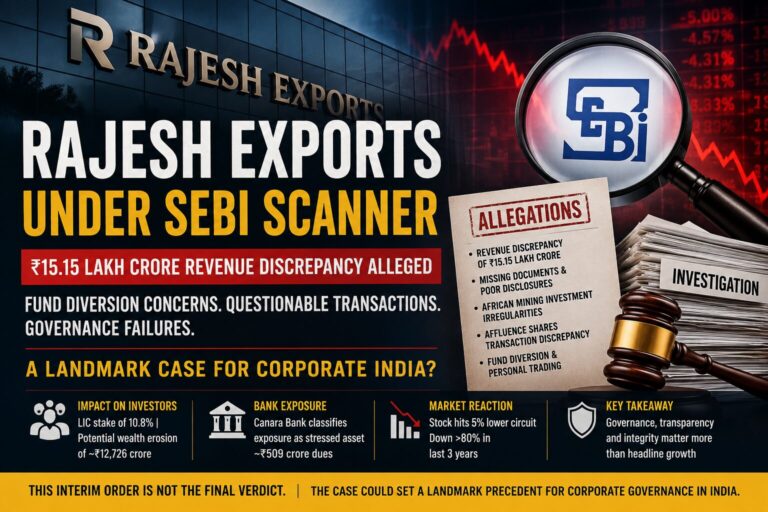
At the heart of SEBI’s investigation lies an alleged revenue discrepancy of ₹15.15 lakh crore spanning FY21 to FY25—one of the largest accounting irregularities ever examined in Indian corporate history.
According to the regulator, between 97% and 99% of Rajesh Exports’ consolidated revenue during the period originated from overseas subsidiaries, particularly Valcambi SA. However, investigators reportedly found that the revenues disclosed in the consolidated financial statements could not be adequately reconciled with records available at the subsidiary level.
The issue first surfaced after a shareholder complaint raised concerns regarding unusually large trade receivables that had remained outstanding for more than two years. What began as a question about receivables eventually evolved into a much broader examination of revenue recognition and financial reporting practices.
If proven, the allegations would raise serious questions about the reliability of reported revenues, one of the most closely watched metrics by investors and analysts.
SEBI’s order also highlights the difficulties faced by investigators and forensic auditors during the course of the probe.
The regulator alleges that several critical documents requested during the investigation were either unavailable or not provided. Auditors reportedly faced limitations due to incomplete customer records, vendor details, and subsidiary financial statements. These gaps made it difficult to independently verify a significant portion of the transactions underlying the company’s reported revenues.
In financial investigations, the inability to substantiate transactions can often become as significant as the transactions themselves. Transparency and documentation form the foundation of investor trust, and any breakdown in that process naturally attracts regulatory scrutiny.
Another area under examination is Rajesh Exports’ reported investment of approximately ₹1,035 crore in African gold mining assets.
SEBI has questioned the adequacy of supporting documentation, valuation reports, and asset-level reconciliations relating to these investments. The regulator has expressed concerns that certain assets may have been overstated, though these findings remain subject to further proceedings and responses from the company.
For investors, the issue reinforces a broader lesson: balance sheet strength is only as credible as the evidence supporting asset valuations.
Among the more striking observations in the order is an alleged discrepancy involving transactions with Affluence Shares and Stocks Pvt. Ltd.
Rajesh Exports reportedly recorded sales of ₹11,487 crore and purchases of ₹11,488 crore involving the entity. However, the counterparty is said to have denied carrying out these transactions.
Such contradictions are often viewed by regulators as serious warning signals because they raise questions about the authenticity and verification of reported business activity.
Whether these discrepancies stem from accounting errors, documentation failures, or more serious issues will ultimately be determined through the legal and regulatory process.
SEBI has also alleged that company funds were transferred to promoter Rajesh Mehta’s personal accounts, with approximately ₹7.4 crore reportedly used for personal derivatives trading.
According to the order, these transactions were neither approved by the board nor disclosed as related-party transactions. The regulator further alleges inconsistencies between company records and personal trading accounts, although some of the funds were subsequently returned.
Corporate governance frameworks exist precisely to prevent such situations. Even relatively small amounts can become significant when they indicate potential weaknesses in internal controls and oversight mechanisms.
The implications extend far beyond the company itself.
Life Insurance Corporation of India (LIC), one of the country’s largest institutional investors, owns approximately 10.8% of Rajesh Exports. SEBI estimates that shareholder wealth erosion linked to the developments could amount to nearly ₹12,726 crore.
The market reaction has been swift. Following the regulator’s order, Rajesh Exports shares hit the 5% lower circuit. The stock has already lost more than 80% of its value over the past three years, reflecting growing concerns over debt pressures, operational challenges, and governance issues.
Separately, Canara Bank has reportedly classified its exposure to the company as a stressed asset, with dues estimated at around ₹509 crore. The bank has initiated steps to auction the exposure, adding another layer of concern for investors.
While the allegations against Rajesh Exports are significant, the larger issue extends beyond a single company.
The case raises important questions about corporate governance standards, auditor oversight, disclosure quality, board effectiveness, and the mechanisms designed to protect minority shareholders. It serves as a reminder that strong revenue growth and impressive headline numbers are not substitutes for transparency, accountability, and sound governance.
History has repeatedly shown that when governance standards weaken, shareholder value can be destroyed far more rapidly than it is created.
For investors, the Rajesh Exports episode offers several important lessons.
First, revenue growth should never be viewed in isolation. The quality of earnings, cash flow generation, receivable trends, and balance sheet strength often provide a more complete picture of corporate health.
Second, governance matters. Companies with transparent disclosures, strong boards, conservative accounting practices, and clear capital allocation policies generally deserve a valuation premium.
Third, investors should pay close attention to auditor qualifications, regulatory observations, debt levels, and related-party transactions. These factors frequently provide early warning signs before larger issues emerge.
Finally, diversification remains one of the most effective risk-management tools. Concentrated exposure to a single stock can significantly magnify the impact of unforeseen governance failures.
It is important to remember that SEBI’s order is interim and not a final verdict. Rajesh Exports and Rajesh Mehta will have the opportunity to present their defence and respond to the allegations.
However, if the charges are ultimately substantiated, the consequences could include substantial monetary penalties, disgorgement of gains, long-term market restrictions, and additional enforcement actions.
Regardless of the eventual outcome, the case is already shaping up to be one of the most consequential corporate governance investigations in recent Indian market history. For investors, the message is clear: financial performance may attract attention, but governance determines sustainability. In the long run, integrity remains one of the most valuable assets any company can possess.
Disclaimer – The stock/s and indices mentioned in this article is discussed solely for informational and educational purposes. It should not be construed as investment advice or a recommendation to buy or sell any securities. Investors should conduct their own research or consult a financial advisor before making any investment decisions. Investments in securities market are subject to market risks. Read all the related documents carefully before investing.
Related Tags


 IIFL Customer Care Number
(Gold/NCD/NBFC/Insurance/NPS)
1860-267-3000 / 7039-050-000
 IIFL Capital Services Support WhatsApp Number
+91 9892691696
Download The App Now


Follow us on


2026, IIFL Capital Services Ltd. All Rights Reserved

IIFL Capital Services Limited - Stock Broker SEBI Regn. No: INZ000164132 (Member ID - NSE: 10975 BSE: 179 MCX: 55995 NCDEX: 01249), DP SEBI Reg. No. IN-DP-185-2016, IA SEBI Regn. No: INA000000623, Merchant Banker SEBI Regn. No. INM000010940, RA SEBI Regn. No: INH000000248, BSE Enlistment Number (RA): 5016, AMFI-Registered Mutual Fund Distributor & SIF Distributor
ARN NO : 47791 (Date of initial registration – 17/02/2007; Current validity of ARN – 08/02/2027), PFRDA Reg. No. PoP 20092018, IRDAI Corporate Agent (Composite) : CA1099

This Certificate Demonstrates That IIFL As An Organization Has Defined And Put In Place Best-Practice Information Security Processes.