2 Jun 2026 , 01:37 PM
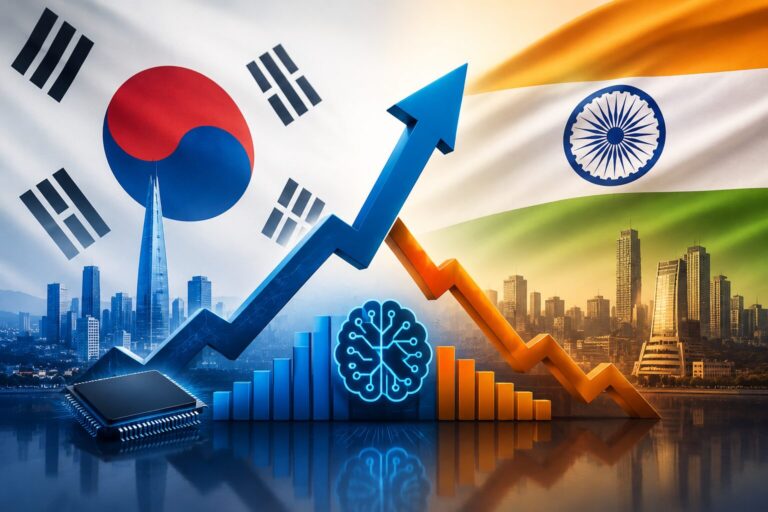
South Korea has surpassed India to become the world’s sixth-largest equity market by total market capitalization, highlighting the growing influence of artificial intelligence (AI) and semiconductor stocks on global investment flows.
According to recent market data, the combined value of South Korean-listed companies has surged to approximately $5 trillion, overtaking India’s market capitalization of around $4.8 trillion. The development reflects a dramatic shift in investor preferences toward companies positioned to benefit from the global AI infrastructure boom.
The primary driver behind South Korea’s remarkable rise has been the explosive performance of its semiconductor industry. Global demand for advanced chips used in AI data centers, cloud computing, and machine learning applications has significantly boosted valuations across the sector.
Leading the charge are Samsung Electronics and SK Hynix, two of the world’s most important memory chip manufacturers. Both companies have emerged as major beneficiaries of increasing investments in AI infrastructure, attracting substantial capital from global investors seeking exposure to the next phase of technological growth.
The AI-driven rally has transformed South Korea into one of the strongest-performing equity markets globally in 2026, with the total value of Korean-listed companies increasing by nearly 86% during the year.
Beyond the semiconductor boom, South Korea’s stock market has also benefited from improving corporate governance standards.
President Lee Jae Myung’s reform agenda has focused on enhancing shareholder rights, increasing transparency, and encouraging more shareholder-friendly corporate policies. These measures have helped improve investor sentiment toward Korean equities, contributing to a broader market re-rating.
For years, South Korean stocks traded at a discount compared with global peers due to governance concerns. Recent reforms have begun to narrow that gap, creating an additional catalyst for market gains.
Despite the impressive rally, investors remain cautious about the concentration of market gains.
A significant portion of South Korea’s market capitalization growth has been driven by a relatively small number of semiconductor companies. This raises questions about whether the broader market can sustain its momentum if AI-related demand slows or semiconductor cycles weaken.
The long-term success of South Korea’s market re-rating may ultimately depend on whether corporate reforms extend benefits across multiple sectors beyond technology and semiconductors.
While South Korea has enjoyed strong momentum, India’s equity market has faced several challenges in 2026.
Among the key headwinds are:
Foreign institutional investors have reportedly withdrawn approximately $26 billion from Indian equities this year, weighing heavily on market performance and investor sentiment.
As a result, India’s benchmark stock indices have experienced their most challenging year in over a decade, with the broader market down roughly 11%.
Despite recent market underperformance, India’s structural growth outlook remains intact.
India’s economy, estimated at approximately $4.15 trillion, is more than twice the size of South Korea’s economy. The country continues to rank among the world’s fastest-growing major economies, supported by favorable demographics, urbanization, digital adoption, and rising income levels.
Many long-term investors remain focused on India’s domestic consumption story. As GDP per capita continues to rise, consumer spending is expected to become an increasingly powerful driver of economic growth.
India’s GDP per capita has recently reached approximately $2,810, moving closer to the widely discussed $4,000 threshold that often marks a significant acceleration in discretionary consumer spending and middle-class expansion.
Looking ahead, investors should closely watch several developments:
South Korea’s rise above India in global market capitalization rankings underscores the market’s current preference for AI beneficiaries and semiconductor leaders. The country’s success highlights how transformative technologies can rapidly reshape global investment landscapes.
However, market capitalization rankings do not necessarily determine long-term investment outcomes. South Korea’s rally remains closely tied to the semiconductor cycle and AI spending trends, while India’s investment thesis continues to rest on economic expansion, demographic advantages, rising consumption, and structural reforms.
For investors, the key question is whether South Korea can sustain its AI-driven momentum and whether India can navigate current macroeconomic challenges while capitalizing on its long-term growth potential. Both markets offer unique opportunities, but their future performance will likely be driven by very different economic and investment narratives.
Related Tags


 IIFL Customer Care Number
(Gold/NCD/NBFC/Insurance/NPS)
1860-267-3000 / 7039-050-000
 IIFL Capital Services Support WhatsApp Number
+91 9892691696
Download The App Now


Follow us on


2026, IIFL Capital Services Ltd. All Rights Reserved

IIFL Capital Services Limited - Stock Broker SEBI Regn. No: INZ000164132 (Member ID - NSE: 10975 BSE: 179 MCX: 55995 NCDEX: 01249), DP SEBI Reg. No. IN-DP-185-2016, IA SEBI Regn. No: INA000000623, Merchant Banker SEBI Regn. No. INM000010940, RA SEBI Regn. No: INH000000248, BSE Enlistment Number (RA): 5016, AMFI-Registered Mutual Fund Distributor & SIF Distributor
ARN NO : 47791 (Date of initial registration – 17/02/2007; Current validity of ARN – 08/02/2027), PFRDA Reg. No. PoP 20092018, IRDAI Corporate Agent (Composite) : CA1099

This Certificate Demonstrates That IIFL As An Organization Has Defined And Put In Place Best-Practice Information Security Processes.