Across the 160-kilometre stretch of water that separates Taiwan from mainland China, one of the most consequential geopolitical standoffs of the 21st century plays out in slow motion. It is a dispute rooted in civil war, hardened by decades of separate governance, and now amplified by the fact that a small island of 23 million people produces the semiconductors on which the entire global economy depends. Understanding the Taiwan question requires understanding its history, its economics, and the extraordinary stakes it poses — for Asia, for the United States, and for countries like India that sit uncomfortably in its shadow.
Taiwan’s story begins long before the modern dispute. The island’s earliest inhabitants were Austronesian peoples, whose descendants still live there today. Chinese records make mention of the island as early as AD 239, though sustained settlement from the mainland came much later. For a period in the 17th century, Taiwan fell under Dutch colonial administration before being taken over by China’s Qing dynasty.
The decisive rupture with China came in 1895. After defeat in the First Sino-Japanese War, the Qing government ceded Taiwan to Japan under the Treaty of Shimonoseki. Japan ruled the island for the next half-century, developing its infrastructure and imposing its language and culture on the population. That chapter ended in 1945 when Japan surrendered at the close of World War II, and Taiwan was handed back to the Republic of China (ROC), the government then ruling mainland China.
What followed was one of modern history’s most consequential military defeats. China’s Nationalist government, led by Chiang Kai-shek, lost a prolonged civil war to Mao Zedong’s Communist forces. In 1949, Mao proclaimed the People’s Republic of China (PRC) on the mainland. The defeated Nationalists, along with roughly two million soldiers and civilians, retreated across the strait to Taiwan, carrying the ROC government — and its claim to be the legitimate government of all China — with them.
That claim, and Beijing’s counter-claim, have never been resolved. They remain the legal and political core of the Taiwan dispute today.
What began as a government in exile has become something far more durable: a functioning liberal democracy with its own constitution, elected government, independent military, and a distinct Taiwanese identity that polls consistently show is strengthening with each generation. An increasing majority of Taiwan’s people identify as Taiwanese rather than Chinese.
Taiwan is no longer a political question waiting to be settled. It is, for the 23 million people who live there, a country.
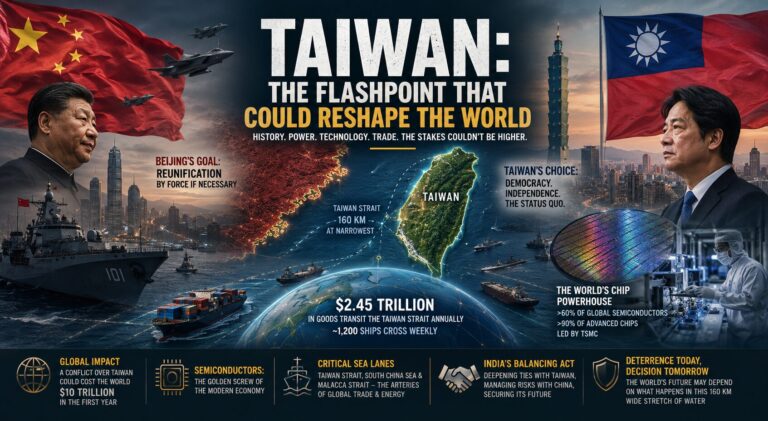
Economically, Taiwan’s transformation is nothing short of remarkable. It is a global powerhouse in semiconductor manufacturing, producing over 60 per cent of the world’s semiconductors and more than 90 per cent of the most advanced chips — those built at 7 nanometres or below. The Taiwan Semiconductor Manufacturing Company (TSMC) alone is the irreplaceable supplier of leading-edge chips to virtually every major technology company on earth, from Apple to Nvidia to Qualcomm.
Taiwan’s democratic credentials and economic weight stand in sharp contrast to its diplomatic isolation. Most countries in the world, following the People’s Republic of China’s demands, do not formally recognise Taiwan as a sovereign state. Instead, they adhere to variants of the ‘One China Policy’, acknowledging — though not necessarily accepting — Beijing’s position that Taiwan is part of China.
The decisive turning point came on 25 October 1971, when the United Nations General Assembly passed Resolution 2758, transferring the ‘China seat’ — including the permanent Security Council seat — from the ROC in Taipei to the PRC in Beijing. The ROC was expelled. Since then, Taiwan has been excluded from the UN and most of its affiliated bodies.
As of 2025, only 12 countries maintain full diplomatic relations with Taiwan — a number that has declined steadily as Beijing’s economic leverage has grown. The most recent defection was Nauru, which switched recognition to Beijing in January 2024. Taiwan’s remaining formal allies are almost all small developing nations, concentrated in the Pacific and Latin America, with the Vatican as the sole European exception.
Yet formal isolation tells only part of the story. Taiwan maintains substantive unofficial relations — trade, cultural, and security ties — with dozens of countries. The United States, Japan, the European Union, and India all engage with Taiwan through unofficial channels, representative offices, and deepening commercial links.
For the Chinese Communist Party, Taiwan is not a foreign policy issue — it is a domestic one. Beijing regards Taiwan as a breakaway province that has not yet been reunified with the motherland, a situation it describes as a temporary aberration of history that must eventually be corrected, by peaceful means if possible, by force if necessary.
In 2005, China codified this position by passing an Anti-Secession Law, which explicitly authorises military action if Taiwan declares formal independence or if peaceful reunification becomes impossible. Since then, China has dramatically expanded its military capabilities, conducting increasingly large-scale drills around Taiwan — including the ‘Joint Sword’ exercises of 2024 — that simulate blockades and amphibious assaults.
Under Xi Jinping, the rhetorical and military pressure has intensified. Xi has spoken of reunification as a mission that cannot be ‘passed on from generation to generation’, and the PLA’s modernisation programme is widely assessed to be oriented, in significant part, around the capability to take Taiwan by force.
Taiwan’s position is more pragmatic than it is declaratory. The island’s government does not formally declare independence — doing so would almost certainly trigger a military response from Beijing. But it insists, with considerable justification, that it is already functionally independent: it has its own government, military, currency, passport, and democratic system. It simply lacks universal recognition.
The majority of Taiwan’s population, surveys consistently show, prefers the status quo: neither formal unification with the mainland nor a formal declaration of independence. They want, in essence, to continue living as they already do. Taiwan’s current president, Lai Ching-te (also known as William Lai), who took office in 2024, is regarded by Beijing as a ‘separatist’ — a designation Taipei disputes.
Washington’s Taiwan policy is a study in deliberate ambiguity. The United States formally recognised the PRC in 1979, switching diplomatic recognition from Taipei to Beijing. Yet it simultaneously passed the Taiwan Relations Act — legislation that has defined American engagement with Taiwan ever since.
The Taiwan Relations Act commits the United States to selling Taiwan defensive weapons, to maintaining the capacity to resist coercive force against the island, and to treating any non-peaceful attempt to determine Taiwan’s future as a matter of ‘grave concern’. What it does not do is unambiguously commit the United States to military intervention in Taiwan’s defence.
In practice, the United States is Taiwan’s most important security partner. It sells Taiwan advanced weapons systems, conducts freedom-of-navigation operations through the Taiwan Strait, and has, in recent years, made increasingly explicit statements about its willingness to defend Taiwan in the event of an unprovoked attack. Whether those statements represent a genuine policy shift away from ambiguity, or rhetorical reassurance without legal consequence, remains debated.
Of all the major powers watching the Taiwan situation, India’s position is perhaps the most structurally uncomfortable. It officially adheres to the One China Policy — though notably, since around 2010, New Delhi has stopped mentioning this explicitly in joint statements with Beijing. India has no formal diplomatic relations with Taiwan, maintaining contact through the India-Taipei Association and the Taipei Economic and Cultural Center.
But beneath the surface of diplomatic caution, India and Taiwan are quietly deepening their relationship at a pace that would have seemed remarkable a decade ago.
In 2024, for the first time, bilateral trade between India and Taiwan exceeded $10 billion — reaching a record $10.6 billion. This is not coincidental. Taiwan’s strategic need to diversify its manufacturing base away from China aligns directly with India’s ambitions to become a global electronics and semiconductor hub under its ‘Make in India’ programme.
Taiwanese investment in India has surged accordingly. As of early 2024, Taiwanese companies had invested approximately $4.5 billion in India across electronics, information technology, and industrial sectors. Foxconn, the world’s largest contract manufacturer and TSMC’s closest peer in the supply chain, has expanded aggressively in India. Its chairman received the Padma Bhushan — India’s third-highest civilian honour — in 2024, a signal of how seriously New Delhi takes this relationship.
India imports roughly 15 per cent of its semiconductors by value from Taiwan, and approximately 55 per cent from China and Hong Kong combined. This concentration is a source of significant strategic vulnerability: if both supply chains were disrupted simultaneously — which any conflict over Taiwan would almost certainly cause — India’s electronics and manufacturing sectors would face an acute crisis.
India’s trade relationship with China is, by any measure, lopsided and worsening. In the financial year 2024-25, India’s trade deficit with China reached a record $99.2 billion — more than double the $44 billion gap recorded just four years earlier. India imports from China primarily electronics, batteries, and industrial components; it exports back largely iron ore and raw materials. It is the trade structure of a dependency, not a partnership.
A free and independent Taiwan, by contrast, represents a far healthier economic relationship for India — and, increasingly, a strategic one. Taiwan’s continued independence keeps Chinese military attention focused eastward, limiting the PRC’s capacity to project power into the Indian Ocean, where India’s most vital interests lie.

To understand why Taiwan matters far beyond the politics of Chinese reunification, one must look at a map — and at the extraordinary concentration of global trade that passes through the waters around it.
At its narrowest, the Taiwan Strait is approximately 130 to 160 kilometres wide. Yet this sliver of ocean carries extraordinary freight. According to the Centre for Strategic and International Studies, approximately $2.45 trillion worth of goods — more than one-fifth of all global maritime trade — transited the strait in 2022 alone. In a typical week in 2023, around 1,200 ships crossed the strait, making it the second-busiest of six major global shipping routes. Electronics, liquefied natural gas, crude oil, bulk cargo — the sinews of the modern global economy flow through here daily.
The Taiwan Strait does not exist in isolation. It is the northern terminus of a corridor that stretches south through the South China Sea to the Strait of Malacca — the passage connecting the Indian Ocean to East Asia. Approximately 80 per cent of China’s oil imports travel through this corridor. India’s exports to Southeast Asia and Japan move along these same lanes. Taiwan sits at the northern gateway, its position making it, as analysts frequently note, the ‘lock on China’s door to the Pacific’.
Military strategists have long discussed the ‘First Island Chain’ — a string of islands stretching from Japan through Taiwan and the Philippines to northern Borneo that forms a natural geographic barrier between China’s coastal waters and the open Pacific Ocean. For China’s navy to project power into the Pacific, it must pass through or around this chain.
Taiwan sits at the centre of that chain. Its control by a friendly or neutral government constrains China’s naval freedom of movement. If Taiwan were to fall under PRC control, that constraint would be removed. China’s navy would gain free access to the Pacific, and the ability to treat the Taiwan Strait as its own territorial waters — with the power to charge, restrict, or deny passage for any nation’s ships.
Beyond the immediate military implications, a Chinese takeover would also give Beijing access to TSMC’s world-leading semiconductor fabrication technology — potentially accelerating China’s own chip ambitions by decades. The United States has explicitly warned that it would destroy Taiwan’s fabrication facilities before allowing them to fall into Chinese hands. Whether that threat is credible — and what its execution would mean for the global technology industry — is one of the darker strategic questions of our time.
The question of what a conflict over Taiwan would cost the world has been subjected to rigorous economic modelling. The results are sobering.
Bloomberg Economics, in a January 2024 analysis, estimated that a full-scale US-China war over Taiwan would deliver a shock of approximately $10 trillion to the global economy — equivalent to roughly 10 per cent of global GDP — in the first year alone. That figure would dwarf the economic damage caused by the Covid-19 pandemic, the 2008 global financial crisis, and the war in Ukraine combined.
Even a blockade scenario — China severing Taiwan’s trade links without direct military assault — carries a global cost estimated at approximately $2.7 trillion by Bloomberg Economics. The primary mechanism of damage, in either scenario, is the disruption to semiconductor supply chains. Since Taiwan produces the advanced chips that are the ‘golden screw’ of global manufacturing — the irreplaceable component in everything from smartphones to automobiles to defence systems — their absence cascades through the entire economy.
For Japan and South Korea, whose trade routes and energy supplies are heavily concentrated through the Taiwan Strait and South China Sea, the effects would be existential in economic terms. For the United States, the loss of advanced chips alone would stall entire sectors of the economy. For India, the combination of semiconductor supply disruption, spiking oil prices, and a Chinese military now freed from its eastern focus would represent a convergence of crises it is poorly positioned to absorb.
A war over Taiwan would not be a regional conflict. It would be a global economic catastrophe with no historical precedent in peacetime.
The semiconductor story is real, but it is not the whole story. What China wants from Taiwan is not primarily TSMC’s fabs — it is the ocean.
China is the world’s largest trading nation, and yet its maritime access is structurally constrained. Its ports and naval bases sit behind the First Island Chain, through which any significant naval deployment must pass. Taiwan is the central link in that chain. Control of Taiwan would allow China to project military power deep into the Pacific, to dominate the sea lanes through which the region’s energy and commerce flow, and to fundamentally alter the balance of naval power in Asia.
This is not hypothetical. It is the strategic logic that drives the PLA’s modernisation, Xi Jinping’s rhetoric, and China’s increasingly aggressive military posture around Taiwan. Chips are a prize. The ocean is the goal.
The Taiwan situation is often described as a frozen conflict — one that has persisted for 75 years without resolution. That description is increasingly inaccurate. The balance of forces is shifting: China’s military has grown dramatically; its economic leverage over Taiwan’s remaining diplomatic allies has increased; and the technology competition between the US and China has made Taiwan’s semiconductor industry more geopolitically significant than ever.
China wants reunification. Taiwan wants to preserve its democracy and its de facto independence. The United States wants to deter conflict while avoiding a direct military confrontation with a nuclear-armed peer. India wants stability in the Indo-Pacific while managing its own complicated relationship with Beijing.
None of these goals are easily reconcilable. The status quo endures not because the parties have resolved their differences, but because the cost of changing it — as Bloomberg’s $10 trillion estimate makes plain — is too high for any rational actor to absorb. The Taiwan question is, in this sense, sustained by mutual deterrence: the same logic that has kept the peace for three-quarters of a century, and which grows more precarious with every passing year.
What is certain is that Taiwan is no longer a peripheral concern in global affairs. It is the epicentre of a contest between two superpowers, the anchor of a global technology supply chain, and the fulcrum on which the balance of Pacific power rests. How it is resolved — or whether it is resolved — will define the shape of the world for decades to come.
Key sources: Bloomberg Economics (Jan 2024), CSIS Crossroads of Commerce (2024), Lowy Institute, India Ministry of Commerce & Industry, Global Taiwan Institute, UN Resolution 2758 (1971).
Disclaimer – The information given in this article is only for educational purposes. The article in no way promotes buying or selling or any securities, index/es, derivatives. Investments in securities market are subject to market risks. Read all the related documents carefully before investing.
Related Tags


 IIFL Customer Care Number
(Gold/NCD/NBFC/Insurance/NPS)
1860-267-3000 / 7039-050-000
 IIFL Capital Services Support WhatsApp Number
+91 9892691696
Download The App Now


Follow us on


2026, IIFL Capital Services Ltd. All Rights Reserved

IIFL Capital Services Limited - Stock Broker SEBI Regn. No: INZ000164132 (Member ID - NSE: 10975 BSE: 179 MCX: 55995 NCDEX: 01249), DP SEBI Reg. No. IN-DP-185-2016, IA SEBI Regn. No: INA000000623, Merchant Banker SEBI Regn. No. INM000010940, RA SEBI Regn. No: INH000000248, BSE Enlistment Number (RA): 5016, AMFI-Registered Mutual Fund Distributor & SIF Distributor
ARN NO : 47791 (Date of initial registration – 17/02/2007; Current validity of ARN – 08/02/2027), PFRDA Reg. No. PoP 20092018, IRDAI Corporate Agent (Composite) : CA1099

This Certificate Demonstrates That IIFL As An Organization Has Defined And Put In Place Best-Practice Information Security Processes.