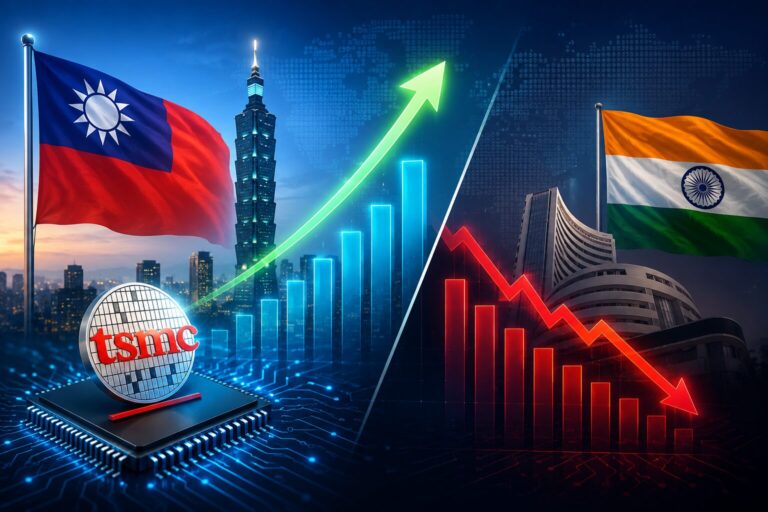
Taiwan has overtaken India in total stock market capitalization, driven largely by the extraordinary rally in semiconductor giant Taiwan Semiconductor Manufacturing Company. The shift reflects a broader global investment trend where capital is increasingly flowing toward countries directly linked to the artificial intelligence infrastructure boom.
Taiwan’s equity market capitalization recently climbed to nearly $5 trillion, surpassing India’s market value as investors aggressively reposition portfolios toward AI-linked hardware and chip manufacturing ecosystems. The development underscores how the AI revolution is reshaping global equity markets and rewarding manufacturing-led technology economies over consumption-driven emerging markets.
Investor optimism surrounding artificial intelligence has triggered unprecedented capital flows into semiconductor and hardware-heavy economies. Countries with deep exposure to chip manufacturing, AI servers, advanced electronics, and semiconductor supply chains are seeing strong market re-ratings.
At the center of Taiwan’s rally is Taiwan Semiconductor Manufacturing Company, the world’s largest contract chipmaker and a critical supplier to major global AI companies. TSMC shares have surged nearly 46–49% in 2026 amid soaring demand for AI processors, data center chips, and advanced semiconductor infrastructure.
Taiwan and South Korea are emerging as major beneficiaries of the AI-led market rally because of their strong exposure to semiconductor manufacturing and tech hardware exports. Investors are increasingly favoring these markets as AI spending accelerates globally.
Taiwan’s financial regulator recently relaxed domestic fund investment rules, a move widely viewed as supportive for TSMC and the broader semiconductor sector.
Under the revised framework:
According to estimates from JPMorgan Chase & Co., the regulatory change could attract more than $6 billion in additional inflows into TSMC shares over time.
The policy shift highlights how governments and regulators are increasingly adapting financial frameworks to capitalize on the global AI investment cycle.
While Taiwan’s markets surged, India has faced multiple macroeconomic and market-related challenges in 2026.
Several factors have weighed on Indian equities:
Unlike Taiwan or South Korea, India’s listed market remains more heavily tilted toward financials, consumption, services, and domestic demand sectors rather than semiconductor manufacturing or advanced hardware production.
Foreign institutional investors have reportedly withdrawn nearly $24 billion from Indian equities this year, reallocating capital toward AI-linked markets such as Taiwan and South Korea.
India’s benchmark indices are down around 8% this year, potentially marking the first annual decline after nearly a decade of sustained gains.
The changing global investment narrative is also visible in benchmark emerging market indices.
India’s weight in the MSCI Emerging Markets Index has reportedly dropped from around 19% last year to nearly 12% currently. The decline reflects both weaker market performance and stronger outperformance from AI-linked Asian economies.
Global investors are increasingly prioritizing countries positioned directly within the semiconductor and AI infrastructure value chain rather than broader domestic consumption stories.
Despite Taiwan overtaking India in stock market capitalization, India’s economy remains substantially larger in absolute terms.
The divergence highlights an important distinction between stock market performance and underlying economic size.
Taiwan’s stock market gains are being driven heavily by a concentrated semiconductor ecosystem led by TSMC, whereas India’s economy remains more diversified and domestically driven.
Analysts caution that Taiwan’s rally also carries concentration risks.
A significant portion of Taiwan’s market gains has been driven by a single company — Taiwan Semiconductor Manufacturing Company. This makes Taiwan’s equity market heavily dependent on semiconductor demand cycles and the continued expansion of global AI infrastructure spending.
Any slowdown in AI investment, semiconductor demand normalization, geopolitical tensions, or cyclical weakness in the chip industry could expose Taiwan’s markets to heightened volatility.
Still, for now, global investors continue to reward economies positioned at the core of the AI revolution.
Taiwan surpassing India in stock market value marks a defining moment in the global AI investment cycle. The development reflects how artificial intelligence is reshaping capital allocation worldwide, with investors favoring semiconductor manufacturing hubs and hardware-driven economies.
While India continues to remain one of the world’s largest and fastest-growing economies, markets currently linked more directly to AI infrastructure, chips, and advanced electronics are attracting stronger investor interest.
The trend also reinforces a broader market reality: in the current cycle, countries powering the AI ecosystem are commanding premium valuations and global capital flows.
Related Tags


 IIFL Customer Care Number
(Gold/NCD/NBFC/Insurance/NPS)
1860-267-3000 / 7039-050-000
 IIFL Capital Services Support WhatsApp Number
+91 9892691696
Download The App Now


Follow us on


2026, IIFL Capital Services Ltd. All Rights Reserved

IIFL Capital Services Limited - Stock Broker SEBI Regn. No: INZ000164132 (Member ID - NSE: 10975 BSE: 179 MCX: 55995 NCDEX: 01249), DP SEBI Reg. No. IN-DP-185-2016, IA SEBI Regn. No: INA000000623, Merchant Banker SEBI Regn. No. INM000010940, RA SEBI Regn. No: INH000000248, BSE Enlistment Number (RA): 5016, AMFI-Registered Mutual Fund Distributor & SIF Distributor
ARN NO : 47791 (Date of initial registration – 17/02/2007; Current validity of ARN – 08/02/2027), PFRDA Reg. No. PoP 20092018, IRDAI Corporate Agent (Composite) : CA1099

This Certificate Demonstrates That IIFL As An Organization Has Defined And Put In Place Best-Practice Information Security Processes.