8 Sep 2026 , 08:18 PM
Wall Street returned from the Labor Day break to a sell-off on Tuesday, with rising crude oil prices and renewed tensions between the US and Iran weighing on investor sentiment.
The Dow Jones Industrial Average fell 641 points, or 1.2%, shortly after the opening bell. The S&P 500 was down 0.4%, while the Nasdaq Composite also slipped 0.4%.
The weakness came as investors assessed the latest developments in the Middle East and their potential impact on energy supplies and inflation. With crude prices climbing sharply, traders are also reassessing the path for US interest rates.
Oil was one of the biggest drivers of the day’s market moves.
Brent crude hovered around $98 a barrel, while WTI futures rose for a sixth straight session. The latest rally followed fresh US-Iran strikes over the weekend, prompting concerns that the conflict could affect oil production or shipments.
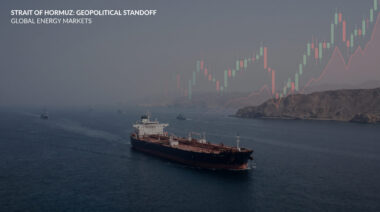
Much of the attention is on the Strait of Hormuz, one of the world’s most important oil transit routes. A prolonged disruption there could tighten global supplies and send prices higher.
That prospect is particularly uncomfortable for markets at a time when investors are already watching inflation closely.
A sustained increase in energy prices could eventually show up in consumer prices through fuel, transportation and other costs.
That has put the Federal Reserve back in focus. Investors had been hoping for a clearer path on interest rates, but a fresh rise in inflation caused by energy prices could make policymakers more cautious.
The next major clues are due later this week. Wholesale inflation data are scheduled for Thursday, followed by consumer inflation data on Friday.
Markets are likely to scrutinise both reports for signs that higher energy costs are beginning to affect broader price pressures.
According to CME Group’s FedWatch tool, traders were pricing in roughly a 60% chance of a 25-basis-point rate hike at the Fed’s upcoming meeting.
The bond market is reflecting some of the same concerns.
The benchmark 10-year US Treasury yield recently moved to its highest level since November 2023, while the 2-year yield reached its highest level since January 2025.
Higher yields can make stocks less attractive relative to bonds and can also put pressure on company valuations. The effect tends to be more noticeable among growth and technology companies, where a larger portion of expected earnings lies further in the future.
That makes the combination of rising crude prices and higher Treasury yields an important one for investors this week.
Energy companies were among the few clear beneficiaries of the jump in crude prices.
The iShares Global Energy ETF (IXC) touched an all-time high, while the SPDR S&P Oil & Gas Exploration & Production ETF (XOP) reached its highest level since June 2015.
Individual oil stocks also posted strong gains. Petrobras rose more than 4%, while PetroChina and APA Corp each gained more than 3%.
The sector’s performance stands in sharp contrast to the broader market decline, as investors looked towards companies that could benefit from stronger oil prices.
Away from energy, Qualcomm was one of the notable movers on Wall Street.
The chipmaker’s shares jumped more than 7% after the company announced a partnership with Amazon Web Services aimed at supporting the development of AI infrastructure.
The announcement comes as spending on artificial intelligence continues to expand beyond traditional GPUs and into a much wider range of computing and networking technologies.
For semiconductor companies, the opportunity is no longer limited to supplying processors. Demand is also growing for solutions that can handle the enormous computing requirements of AI while keeping energy consumption under control.
The Qualcomm-AWS partnership therefore adds another angle to the broader AI infrastructure investment story.
Investors also had to contend with renewed trade friction between the US and Canada.
Canada’s retaliatory tariffs covering roughly $20 billion of US goods took effect on Tuesday. The measures add to an already complicated backdrop for global markets, where investors are dealing with geopolitical tensions, commodity-price volatility and uncertainty over monetary policy.
Trade restrictions can affect everything from supply chains to corporate margins and consumer prices. For markets already worried about inflation, another potential source of cost pressure is unlikely to be welcomed.
For now, oil prices are likely to remain one of the most important signals for Wall Street.
If crude continues to climb because of disruptions in the Middle East, investors may have to adjust their expectations for inflation and interest rates once again. That could keep pressure on bond yields and interest-rate-sensitive parts of the equity market.
The inflation reports due later this week could provide a clearer picture.
A softer-than-expected reading could ease some of the pressure on stocks, particularly if it helps bring down expectations for future rate increases. A hotter inflation print, on the other hand, could reinforce concerns that higher energy prices are feeding into the wider economy.
There is also the geopolitical factor, which remains difficult to predict.
For investors, the immediate watchlist is therefore fairly clear: Brent crude, the Strait of Hormuz, US inflation data, Treasury yields and Federal Reserve rate expectations.
Tuesday’s decline is a reminder that even with the long-running enthusiasm around technology and artificial intelligence, Wall Street remains highly sensitive to developments outside the corporate world. Rising oil prices and geopolitical risks can quickly change the market narrative—and this week, both are firmly back in focus.
Disclaimer – The stock/s and indices mentioned in this article are discussed solely for informational and educational purposes. It should not be construed as investment advice or a recommendation to buy or sell any securities. Investors should conduct their own research or consult a financial advisor before making any investment decisions. Investments in securities markets are subject to market risks. Read all the related documents carefully before investing.
Related Tags


 IIFL Customer Care Number
(Gold/NCD/NBFC/Insurance/NPS)
1860-267-3000 / 7039-050-000
 IIFL Capital Services Support WhatsApp Number
+91 9892691696
Download The App Now


Follow us on


2026, IIFL Capital Services Ltd. All Rights Reserved

IIFL Capital Services Limited - Stock Broker SEBI Regn. No: INZ000164132 (Member ID - NSE: 10975 BSE: 179 MCX: 55995 NCDEX: 01249), DP SEBI Reg. No. IN-DP-185-2016, IA SEBI Regn. No: INA000000623, Merchant Banker SEBI Regn. No. INM000010940, RA SEBI Regn. No: INH000000248, BSE Enlistment Number (RA): 5016, AMFI-Registered Mutual Fund Distributor & SIF Distributor
ARN NO : 47791 (Date of initial registration – 17/02/2007; Current validity of ARN – 08/02/2027), PFRDA Reg. No. PoP 20092018, IRDAI Corporate Agent (Composite) : CA1099

This Certificate Demonstrates That IIFL As An Organization Has Defined And Put In Place Best-Practice Information Security Processes.