
Last Updated: 22 Aug 2026

Table of Content
The Closing Auction Session (CAS) is now live on both NSE and BSE for eligible stocks, and it changes one of the most important numbers in the market: the official closing price. Instead of depending only on the earlier end-of-day method, eligible stocks now move into a dedicated auction window where buy and sell interest is collected and matched at a single equilibrium price. SEBI introduced this framework through its January 16, 2026 circular, and the exchanges made it live from August 3, 2026.
For investors, this matters because the closing price is the market’s official end-of-day mark. For active traders, it matters even more because order handling changes after 3:15 pm. Market orders face restrictions during part of the auction, and price discovery now happens in a structured demand-supply process. If you understand the CAS timetable, the allowed order types, and the logic behind the final match, the closing window becomes much easier to read.
CAS is a separate end-of-day auction session for eligible cash-market stocks.
In Phase 1, NSE says it applies only to stocks in the cash segment on which derivative contracts are available, while BSE’s detailed notice says the rollout is phased and includes certain exchange-specific exclusions.
In simple terms, this means CAS is live, but not every listed stock is automatically a part of it.
The biggest change is this: for CAS-eligible securities, the official closing price is discovered through an auction. BSE’s notice states that if an equilibrium price is discovered during CAS, that becomes the closing price. If no equilibrium price is discovered, the closing reference price is used instead. For securities that are not part of CAS, the old mechanism continues, which BSE describes as the VWAP of the last 30 minutes of the continuous trading session.
This distinction is important. CAS does not replace the closing-price method for the entire market in one shot. It changes price discovery for eligible stocks, while non-CAS securities continue under the existing framework.
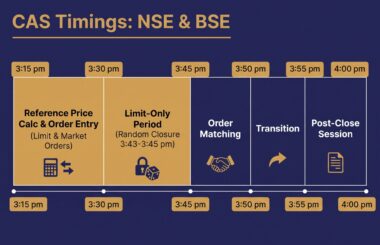
On NSE, CAS runs for 20 minutes from 3:15 pm to 3:35 pm, followed by a transition period until 3:50 pm and the post-close session from 3:50 pm to 4:00 pm. BSE’s operating guidelines align with the same broad time blocks. (Source: NSE CAS page, BSE operating guidelines)
Here is the sequence that matters:
3:15 pm to 3:20 pm: During this time, transition happens from continuous trading to CAS and reference price calculation. NSE says this is the window when the market moves from CTS to CAS. BSE also says the revised price band is disseminated here.
3:20 pm to 3:25 pm: order entry, modification, and cancellation for both limit and market orders happens during this time. No trades are executed in this collection phase.
3:25 pm to 3:30 pm: only limit orders can be added, modified, or cancelled. Market orders cannot be modified or cancelled in this period, and the system can randomly stop order entry during the last 2 minutes.
3:30 pm to 3:35 pm: order matching, trade confirmation, and closing-price determination.
3:35 pm to 3:50 pm: transition or buffer period.
3:50 pm to 4:00 pm: post-close session.
One small but practical point: NSE also notes that non-CAS securities continue in continuous trading until 3:30 pm, while the equity derivatives segment runs until 3:40 pm. So the last part of the trading day is no longer identical across all securities.
CAS also introduces specific pre-trade risk controls.
Orders entered during CAS are subject to applicable margin requirements at the order level. Limit orders carried forward from continuous trading are treated differently and are not subject to the same initial order-level validation unless they are modified during CAS.
The Self-Trade Prevention (STP) mechanism applies during CAS. If the system identifies a potential self-trade during the order collection period, the active order is cancelled by default.
Market Price Protection (MPP) does not apply during CAS. This is an important distinction for investors because market orders are exposed to the auction’s price-discovery mechanism rather than the normal MPP control.
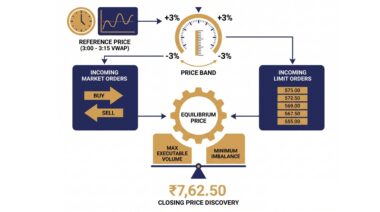
The process starts with the reference price. On NSE, that reference price is the volume-weighted average price, or VWAP, of trades executed in the stock between 3:00 pm and 3:15 pm. BSE uses the same base rule and then adds fallback logic for edge cases.
BSE’s fallback hierarchy is especially useful to know:
if there are no trades in that 3:00 pm to 3:15 pm window, the day’s last traded price is used as the reference price;
if there is no trade during the day, the previous trading day’s close is used;
in a corporate-action case, the adjusted previous close or base price is used.
Once the reference price is known, the CAS price band is set at ±3% around that reference price. Orders outside that revised band are not part of the auction. NSE says limit and market orders are allowed in CAS, while stop-loss and iceberg orders (large orders that are split into smaller visible portions) are not allowed. BSE adds that revealed-quantity orders are not allowed either.
The exchange then looks for the equilibrium price. Both exchanges describe a demand-supply logic built around maximum executable volume. If more than one price can execute the same maximum quantity, the exchange looks for the one with the minimum absolute imbalance. If there is still a tie, the price closest to the reference price is chosen. NSE also notes a midpoint rule: if the reference price is exactly the midpoint of the tied prices, the reference price itself becomes the equilibrium price. In simple terms this means – in CAS, the exchange first finds the price at which the maximum number of shares can be traded. If two prices allow the same quantity to be traded, it looks at the “imbalance” – the difference between the number of shares investors want to buy and sell. For example, if ₹498 and ₹502 both allow 5,000 shares to be traded, the exchange chooses the price where this buy-sell difference is smaller. If both prices have the same difference, it looks at the “reference price” (the price calculated from recent trading). If the reference price is ₹500, and ₹498 and ₹502 are equally close to it, ₹500 becomes the equilibrium price.
Execution priority also changes in a specific order: market orders versus market orders first on time priority, then residual market orders versus limit orders on price-time priority, and finally remaining limit orders versus limit orders on price-time priority. During the auction, exchange also provides traders and investors with the indicative equilibrium price (the price at which the maximum quantity could currently be traded), along with the indicative tradable quantity and order-imbalance information. These data figures can change as orders are added, modified or cancelled during the auction
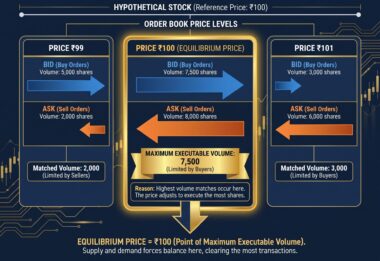
Let’s say a stock enters CAS with a reference price of ₹100. That means the auction band is ₹97 to ₹103 under the ±3% rule. Now imagine the following hypothetical order interest during the auction:
| Price level | Cumulative buy quantity eligible at or above price | Cumulative sell quantity eligible at or below price | Executable quantity |
| ₹99.90 | 1800 | 400 | 400 |
| ₹100.00 | 1400 | 1000 | 1000 |
| ₹100.10 | 700 | 1500 | 700 |
Now, during the auction, the exchange looks at the buy and sell orders available at different prices. Suppose the orders show that 400 shares can be traded at ₹99.90, 1,000 shares at ₹100, and 700 shares at ₹100.10. Since ₹100 allows the largest number of shares – 1,000; to be traded, ₹100 becomes the equilibrium price and, subject to the auction rules, the stock’s closing price.
In simple terms, CAS tries to find the price at which the largest possible number of shares can be traded. (Illustrative example based on exchange auction logic)
Now take an edge case. Suppose there are no trades in a CAS-eligible stock between 3:00 pm and 3:15 pm on BSE. In that case, BSE says the reference price falls back to the day’s last traded price. If there was no trade in the stock all day, the fallback goes one step further to the previous trading day’s closing price, or the adjusted prior close in a corporate-action case. That fallback hierarchy matters because it keeps the auction anchored even on illiquid or unusual days.
For long-term investors, CAS mostly matters as a market-structure change. If you track end-of-day prices, understand that the official close for eligible stocks is now being discovered through a closing auction. That can make the final print easier to interpret when you know it comes from a dedicated matching process rather than only the old last-30-minute method.
For active traders, the implications are more immediate:
Do not assume every stock is in CAS yet; Phase 1 is limited to eligible securities only;
Remember that market orders can be entered from 3:20 pm to 3:25 pm, but not modified or cancelled from 3:25 pm to 3:30 pm;
Use limit orders carefully because only limit orders remain adjustable in the later collection phase;
Do not rely on stop-loss, iceberg, or revealed-quantity style behaviour inside CAS, because those order types are not allowed;
Be aware that carried-forward limit orders can matter, because BSE says they retain time priority unless modified during CAS.
There are also risk-control differences worth noting. NSE and BSE says market price protection is not applicable during CAS, while self-trade prevention remains applicable.
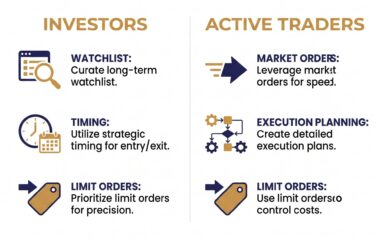
CAS is not just a new label at the end of the trading day. It is a live auction framework on NSE and BSE that changes how the official closing price is discovered for eligible stocks, starting with a phased rollout from August 3, 2026. If you trade near the close, the details matter: eligibility, timing, order-type restrictions, the reference-price band, and the auction logic behind the final match.
If you want more market explainers and investing insights, you can explore more on our knowledge centre for broader research-led perspectives.
(Source: SEBI circular, NSE CAS page, BSE operating guidelines)
The Closing Auction Session (CAS) is a 20-minute auction mechanism used to determine the official closing price of eligible equity stocks. In Phase 1, it applies to cash-segment stocks for which derivative contracts are available.
CAS begins at 3:15 PM. The first five minutes, from 3:15 PM to 3:20 PM, are used for the transition from continuous trading and calculation of the reference price. Order entry begins at 3:20 PM.
No. In Phase 1, CAS applies to stocks in the equity cash segment on which derivative contracts are available. Other stocks continue under the applicable existing closing-price mechanism.
Yes. Under CAS, the official closing price is determined through the equilibrium-price mechanism. Therefore, it can differ from the last traded price recorded before the stock entered the auction.
Yes. NSE and BSE maintain separate order books for their CAS sessions. Since the demand and supply available on each exchange can differ, the equilibrium closing prices can also differ.
No. Stop-loss orders are not allowed in CAS, and eligible stop-loss orders from the continuous trading session are not carried forward into the auction.
The CAS price band is ±3% from the stock’s reference price. The reference price is calculated using the VWAP of trades executed between 3:00 PM and 3:15 PM.
The equilibrium price is primarily the price at which the maximum quantity can be executed. If multiple prices allow the same maximum quantity, the system uses order imbalance and proximity to the reference price as tie-breakers.


 IIFL Customer Care Number
(Gold/NCD/NBFC/Insurance/NPS)
1860-267-3000 / 7039-050-000
 IIFL Capital Services Support WhatsApp Number
+91 9892691696
Download The App Now


Follow us on


2026, IIFL Capital Services Ltd. All Rights Reserved

IIFL Capital Services Limited - Stock Broker SEBI Regn. No: INZ000164132 (Member ID - NSE: 10975 BSE: 179 MCX: 55995 NCDEX: 01249), DP SEBI Reg. No. IN-DP-185-2016, IA SEBI Regn. No: INA000000623, Merchant Banker SEBI Regn. No. INM000010940, RA SEBI Regn. No: INH000000248, BSE Enlistment Number (RA): 5016, AMFI-Registered Mutual Fund Distributor & SIF Distributor
ARN NO : 47791 (Date of initial registration – 17/02/2007; Current validity of ARN – 08/02/2027), PFRDA Reg. No. PoP 20092018, IRDAI Corporate Agent (Composite) : CA1099

This Certificate Demonstrates That IIFL As An Organization Has Defined And Put In Place Best-Practice Information Security Processes.