


Indian stock markets ended sharply higher on July 29, 2026, with the Sensex gaining 888.68 points and the Nifty closing at 24,250.20. The rally was driven by sustained buying in IT stocks, positive FII inflows, lower market volatility, and expectations of an unchanged US Federal Reserve interest rate. Infosys led the IT surge, while broad-based gains across FMCG, Metals, Pharma, and Financials boosted overall market sentiment.
Indian benchmark indices staged a strong recovery on July 27, 2026, ending a five-session losing streak. The Nifty and Sensex gained nearly 1% each, supported by easing US-Iran tensions, a sharp decline in crude oil prices, improved global sentiment, and strong buying in IT, Media, Realty, and Auto stocks. Infosys led the IT rally following leadership transition news and positive brokerage sentiment.
Indian stock market extended its losing streak on July 23, 2026, with the Sensex falling 363 points and the Nifty closing below 23,900. Escalating US-Iran tensions, higher crude oil prices, persistent FII selling, and weak global sentiment weighed on markets, while the Auto sector emerged as the lone outperformer.
Indian benchmark indices ended sharply lower on July 22, 2026, with Sensex falling 715 points and Nifty closing below the 24,000 mark. Investor sentiment weakened after US President Donald Trump's proposed tariffs on imported generic medicines, escalating US-Iran tensions, rising Brent crude oil prices, a weaker rupee, and heavy selling in banking, pharma and IT stocks. Despite the broader market weakness, Bajaj Auto and Nestlé India gained on the back of strong Q1 FY27 earnings.
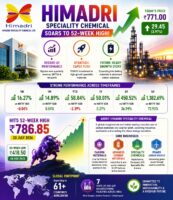
Himadri Speciality Chemical touched a fresh 52-week high after delivering record Q1 FY27 results, improving margins, and unveiling ₹240 crore investments in speciality carbon black and carbon nanotube capacity. Discover the major catalysts driving the stock's strong momentum and long-term growth prospects.
The Indian stock market ended lower on 20 July 2026, with the Sensex dropping 442.93 points and the Nifty 50 slipping 95.80 points amid a sharp sell-off in private banking stocks following Q1 FY27 earnings. Explore today's market highlights, top gainers and losers, trending stocks, sector-wise performance, and the major factors that influenced market sentiment.
Indian benchmark indices ended largely unchanged on July 16, 2026, with IT and Auto stocks supporting the market while Realty and Financial Services lagged. Rising Brent crude prices, fresh US-Iran tensions, weak global cues, and profit booking ahead of the Q1 earnings season kept investor sentiment cautious despite selective sectoral gains.
Sensex and Nifty ended nearly flat after recovering from sharp early losses. A strong rally in TCS, HCL Tech, and the IT sector offset weakness in FMCG, metals, and defence stocks amid geopolitical concerns and higher crude oil prices.
Indian benchmark indices witnessed a broad-based sell-off on July 8, 2026, with the Nifty 50 and Sensex declining more than 2% as renewed US-Iran tensions, soaring crude oil prices, a weaker rupee, and rising market volatility dented investor sentiment. Banking and financial stocks led the decline, while most sectoral indices ended deep in the red amid growing geopolitical uncertainty.
The Indian stock market extended its rally on July 6, 2026, with the Nifty and Sensex closing higher, driven by HDFC Bank's strong Q1 FY27 business update, falling Brent crude prices, sustained FII inflows, and positive global sentiment. Realty, Auto, and Oil & Gas outperformed, while IT, PSU Banks, and Media witnessed profit booking ahead of the earnings season.


 IIFL Customer Care Number
(Gold/NCD/NBFC/Insurance/NPS)
1860-267-3000 / 7039-050-000
 IIFL Capital Services Support WhatsApp Number
+91 9892691696
Download The App Now


Follow us on


2026, IIFL Capital Services Ltd. All Rights Reserved

IIFL Capital Services Limited - Stock Broker SEBI Regn. No: INZ000164132 (Member ID - NSE: 10975 BSE: 179 MCX: 55995 NCDEX: 01249), DP SEBI Reg. No. IN-DP-185-2016, IA SEBI Regn. No: INA000000623, Merchant Banker SEBI Regn. No. INM000010940, RA SEBI Regn. No: INH000000248, BSE Enlistment Number (RA): 5016, AMFI-Registered Mutual Fund Distributor & SIF Distributor
ARN NO : 47791 (Date of initial registration – 17/02/2007; Current validity of ARN – 08/02/2027), PFRDA Reg. No. PoP 20092018, IRDAI Corporate Agent (Composite) : CA1099

This Certificate Demonstrates That IIFL As An Organization Has Defined And Put In Place Best-Practice Information Security Processes.


