

Capital expenditure covers long-term investments in assets, while revenue expenditure includes daily operational costs. Learn more details at India Infoline.

Dividend Payout Ratio is percentage of a company’s net income distributed to shareholders as dividends. Learn how it is calculated with an example, importance of dividend payout ratio.

Learn about dividends, the different types, and their advantages and disadvantages. Understand how they affect share prices with our insight's at India Infoline.

Dividend Per Share (DPS) is the total dividend amount allocated to each outstanding share of a company. Learn how to calculate dividend per share effectively.

A dividend is a portion of a company’s profits distributed to its shareholders, typically in the form of cash, shares, or equivalents. Learn more at India Infoline.

Stock liquidity is a term that is often used while analyzing which stocks to buy. Similar has happened with Arun, who is new to stock market trading. He was learning the nitty-gritty of share market trading when his friend Vipul told him about stock liquidity.
Stock valuation is an important tool that can help you make informed decisions about trading. It is a technique that determines the value of a company's stock by using standard formulas.
A person having the debentures is called debenture holder whereas a person holding the shares is called shareholder.
Liquidation is the process a debt-laden company initiates to wind up its operations and sell its assets in order to repay said liabilities and other obligations. A company is liquidated when it is ascertained that the business is not in any state to continue.

bank Nifty is one of the important indices which comprises of the most liquid and large Indian Banking stocks. Lagging and leading behavior of Bank Nifty can help us to gauge the strength or weakness of the ongoing trend in Nifty.
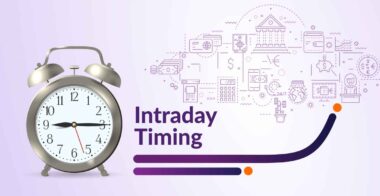
An intraday trade has to opened and closed on the same day. In the rolling settlement, if it is not closed on the same day, then it goes to compulsory delivery. Hence the timing for intraday trading is from 9.15 am to 3.30 pm on a daily basis in the Indian markets.
Cash Reserve Ratio (CRR) is the amount of funds that banks have to maintain with the Reserve Bank of India (RBI) at all times. If the central bank decides to increase the CRR, the amount available with the banks for disbursal comes down.

As a trader, you are not just limited to trading in derivatives in the Indian stock exchanges but can also trade in the same in via SGX Nifty.
Payment for order flow (PFOF) is a type of incentive that a broker receives for directing orders for trade execution to a particular market maker or exchange. The payment is usually a penny per share. It is most common in the options markets and is budding in equity transactions.
Good - Till Triggered (GTT) orders are basically a price alert based order placement or trigger based orders. When a pre-set trigger (Entry Price) is breached, only then the order is placed with exchange to execute the order.


Click icons above to download App for Android or iOS


 IIFL Customer Care Number
(Gold/NCD/NBFC/Insurance/NPS)
1860-267-3000 / 7039-050-000
 IIFL Capital Services Support WhatsApp Number
+91 9892691696
Download The App Now


Follow us on


2026, IIFL Capital Services Ltd. All Rights Reserved

IIFL Capital Services Limited - Stock Broker SEBI Regn. No: INZ000164132 (Member ID - NSE: 10975 BSE: 179 MCX: 55995 NCDEX: 01249), DP SEBI Reg. No. IN-DP-185-2016, IA SEBI Regn. No: INA000000623, Merchant Banker SEBI Regn. No. INM000010940, RA SEBI Regn. No: INH000000248, BSE Enlistment Number (RA): 5016, AMFI-Registered Mutual Fund Distributor & SIF Distributor
ARN NO : 47791 (Date of initial registration – 17/02/2007; Current validity of ARN – 08/02/2027), PFRDA Reg. No. PoP 20092018, IRDAI Corporate Agent (Composite) : CA1099

This Certificate Demonstrates That IIFL As An Organization Has Defined And Put In Place Best-Practice Information Security Processes.